Business casual shoes for women: 7 pairs on one outfit, and the rules
Business casual shoes are loafers, flats, low pumps, oxfords and ankle boots. Where slingbacks, Mary Janes, sandals and sneakers stand, plus heel height.
Wear It On Me earns a commission on garments bought through affiliate links in our guides. That never decides what we recommend. Details.
The shoes to wear with business casual are closed-toe leather shoes with a flat or low heel: loafers, ballet flats, low pumps, oxfords and ankle boots. Indeed's career guide gives the standard list: "Closed-toed shoes such as loafers, Oxfords, boots, pumps or flats". Slingbacks and Mary Janes belong on it too. Sandals and sneakers are where offices differ. To show how much the shoe changes the outfit, this guide puts seven pairs on one woman in one suit, then gives the rules on open toes, heel height and sneakers, with the surveys and the medical advice behind them.
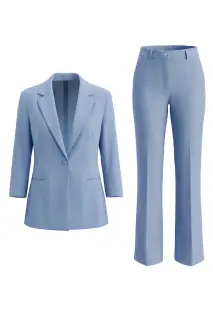 Zapaka Dusty Blue Notched Lapel One Button Slim Fit Long Women Suit $125 Shop at Zapakaaffiliate link
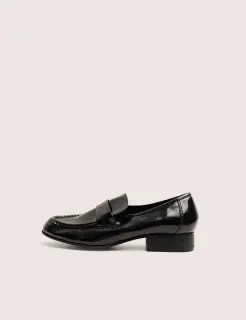 Public Desire UK Haboo Black Loafers £32.99 Shop at Public Desireaffiliate link
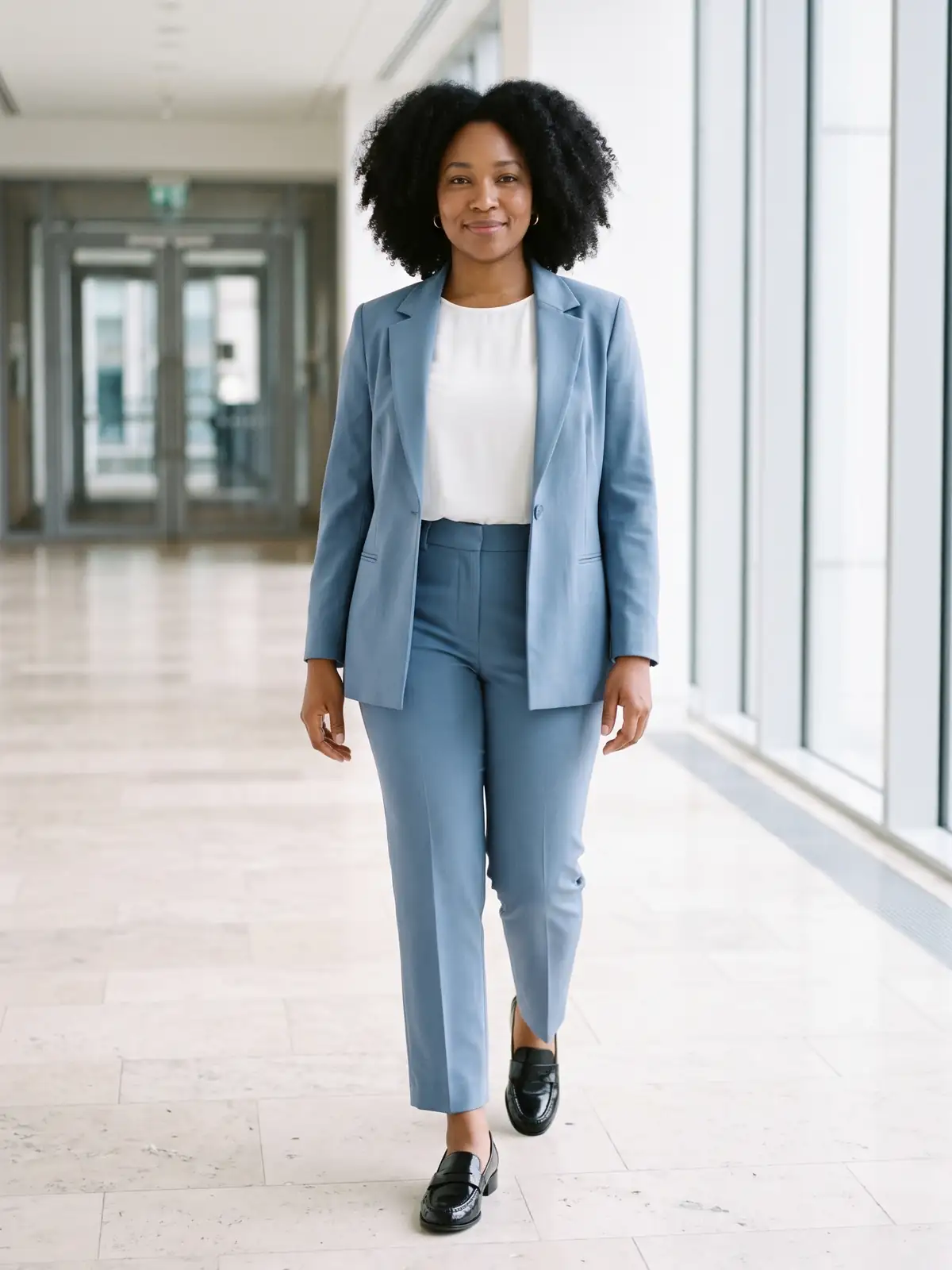
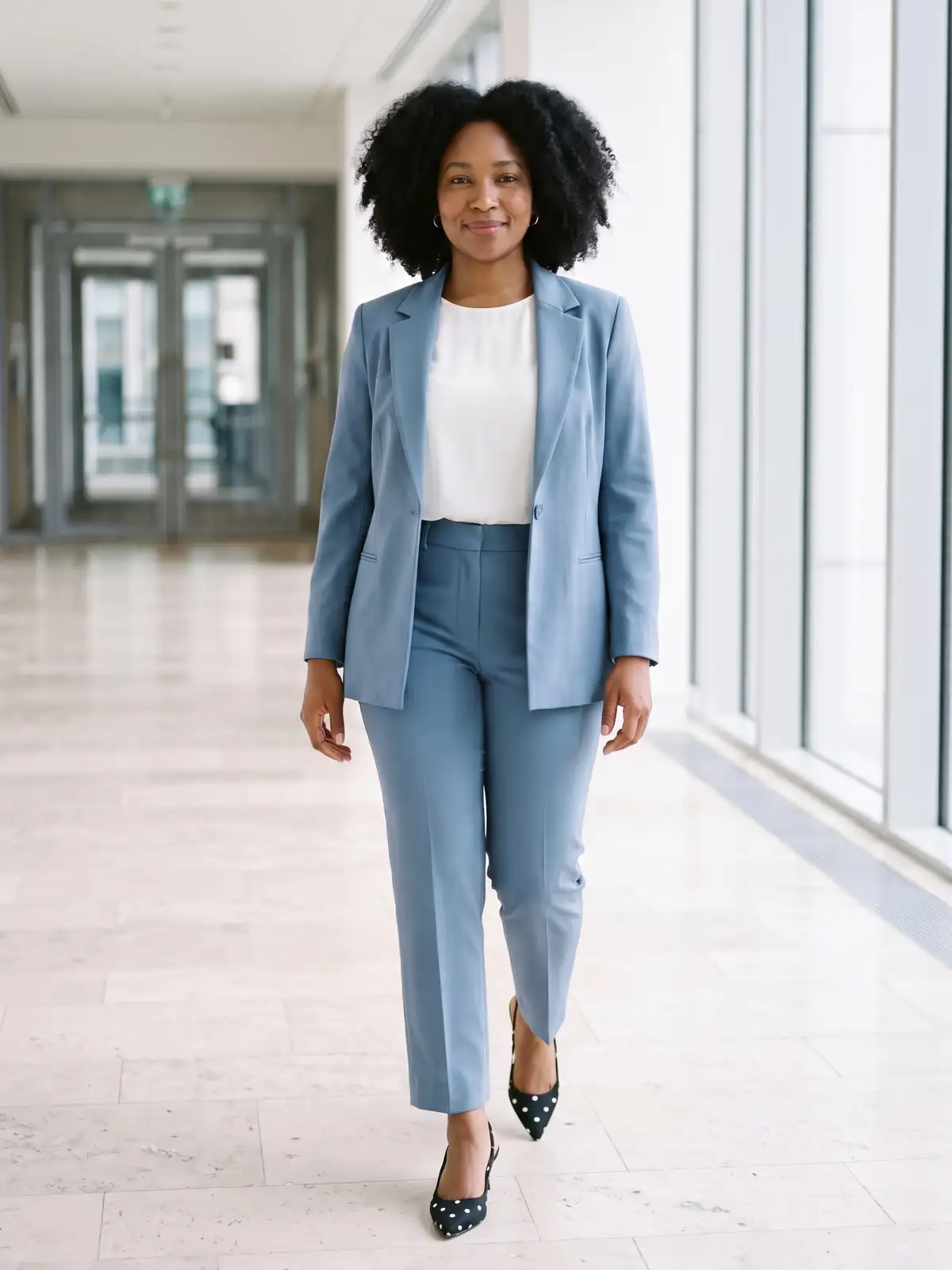
The outfit stays the same in every picture: Zapaka's dusty blue pantsuit with a notched lapel and one button (US$125), worn open over a white top, on a US size 12. The top is described, not sold by the shops we work with. Only the shoes change. The clothes themselves are covered in our guide to business casual for women.
The short answer: which shoes are business casual
| Shoe | Conservative office | Standard office | Relaxed office |
|---|---|---|---|
| Loafers | Yes | Yes | Yes |
| Ballet flats, pointed flats | Yes | Yes | Yes |
| Low pumps, kitten heels | Yes | Yes | Yes |
| Oxfords, brogues | Yes | Yes | Yes |
| Plain ankle boots | Yes | Yes | Yes |
| Knee-high boots under a skirt | Yes | Yes | Yes |
| Slingbacks | Usually | Yes | Yes |
| Mary Janes | Yes in dark leather | Yes | Yes |
| Mules, backless shoes | No | Sometimes | Yes |
| Peep toes | Questionable | Usually | Yes |
| Dressy sandals | No | Sometimes | Yes |
| Plain leather sneakers | No | Sometimes | Yes |
| Running shoes | No | No | Sometimes |
| Flip-flops | No | No | No |
| Heels over four inches | No | No | No |
The first five rows are the answer for a new job, an interview or any day you are not sure. The rest of this guide explains the others.
What makes a shoe business casual
Four things, on which the sources agree.
It covers the foot. Charles & Keith's guide: "Closed-toe, covered shoes in neutral or dark hues are the general recommendation." A reader of Corporette, the blog for women in law and finance, reported the rule her accounting firm uses: a "suggested guideline of more shoe than foot." The Washington Post's office style rules say the same with a ratio: a little toe is fine "as long as the shoe-to-foot visibility ratio remains tipped in the balance of the shoe."
It is made of leather or suede. PrepScholar: "Go for high quality natural materials like leather and suede, simple styles, and comfort in movement." Charles & Keith rules out "soft materials like canvas."
It is classic in shape. WSS, the footwear retailer, on what defines the category: "The style should be timeless". A trend is welcome as a detail, in its words "a chunky sole on a loafer or a fun color".
It is clean and in good repair. SEEK, the Australian job site, makes this the real test: "Footwear may not be suitable when it is dirty, damaged, unsafe for the work or inconsistent with the workplace’s dress code."
Seven business casual shoes, on one outfit
1. Loafers
The picture above. These are Public Desire's Haboo loafers in black patent with a low stacked heel (£33). The loafer is the one shoe on every list: Indeed's, WSS's ("A timeless and versatile shoe that gives many outfits an edge"), and the list of Katherine Theobalds, a shoe designer quoted by The Zoe Report, who recommends "a good dependable loafer". Cole Haan's style guide notes that a sleek sole reads dressier than a lug sole. With ankle-length pants, as here, the whole shoe shows, which is why a polished one is worth having. Our guide to how to style loafers covers the other outfits.
- Zapaka Dusty Blue Notched Lapel One Button Slim Fit Long Women Suit $125 Shop at Zapakaaffiliate link
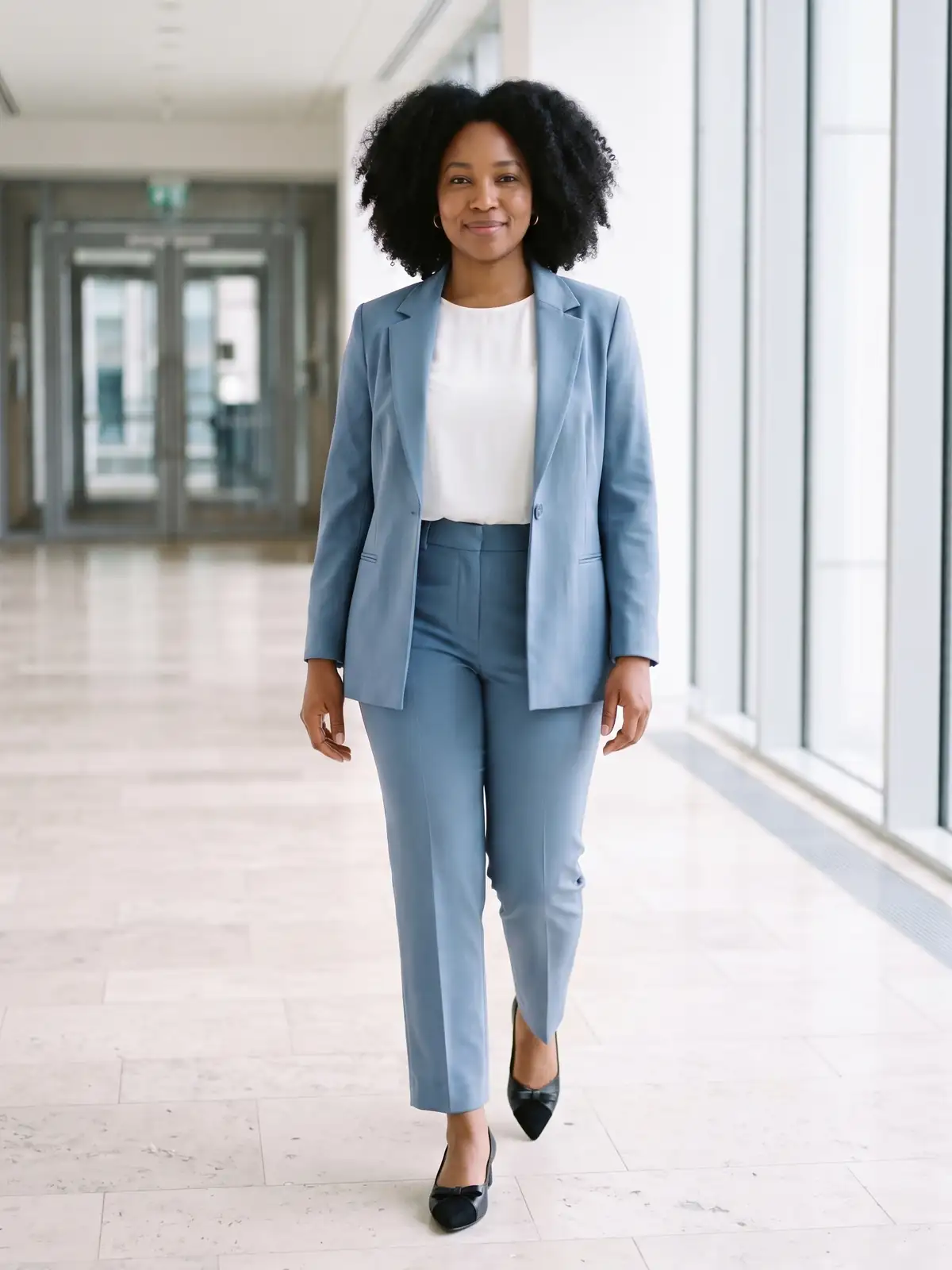
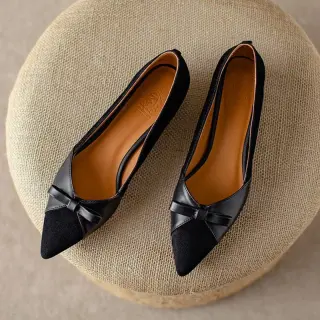 CHIKO Ieasha Pointy Toe Block Heels Pumps Shoes $105 Shop at CHIKOaffiliate link
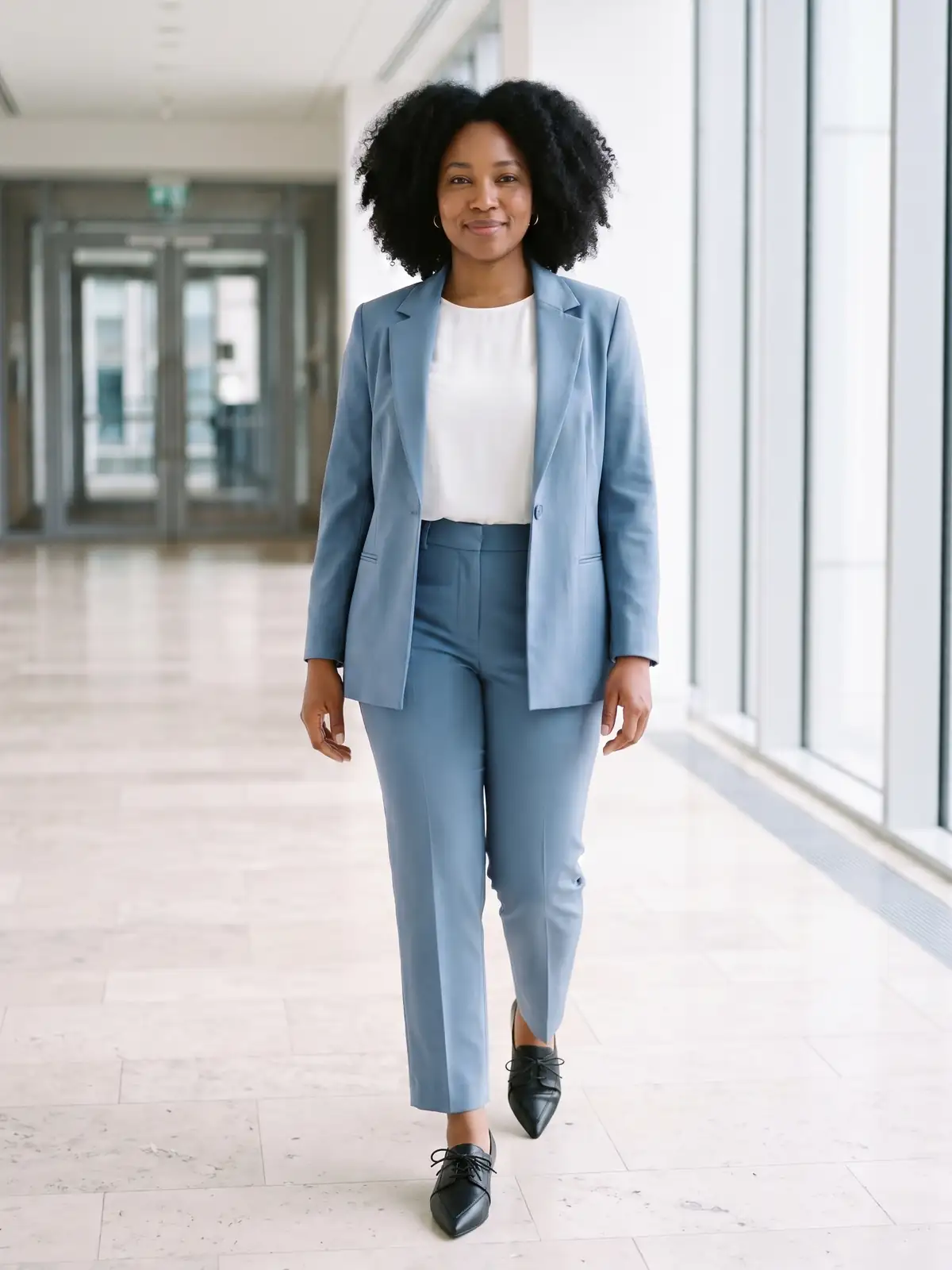
- Zapaka Dusty Blue Notched Lapel One Button Slim Fit Long Women Suit $125 Shop at Zapakaaffiliate link
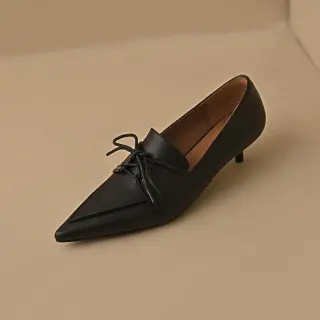 CHIKO Coralee Pointy Toe Kitten Heels Oxfords Shoes $109 Shop at CHIKOaffiliate link
2. Low pumps
On the left: CHIKO's Ieasha pumps, black, pointed, with a small bow and a low block heel (US$105). A closed pump on a low heel is the traditional answer, and it is the pair Corporette tells readers to keep under the desk: "Keep a blazer in the office (and perhaps a pair of classic pumps) to throw on if the opportunity arises to meet an important client." The pointed toe is the dressiest shape; with a suit it reads as nearly formal.
3. Oxfords
On the right: CHIKO's Coralee oxfords, black, pointed, laced, on a kitten heel (US$109). A lace-up is the choice when you want a closed, serious shoe without the look of a pump. Corporette's definitions help with the heel: "Kitten heels are generally under 1.5″ so they can be a great option". The University of Tennessee's speaking center lists the easy category in one line: "oxfords, loafers, flats or small heels".
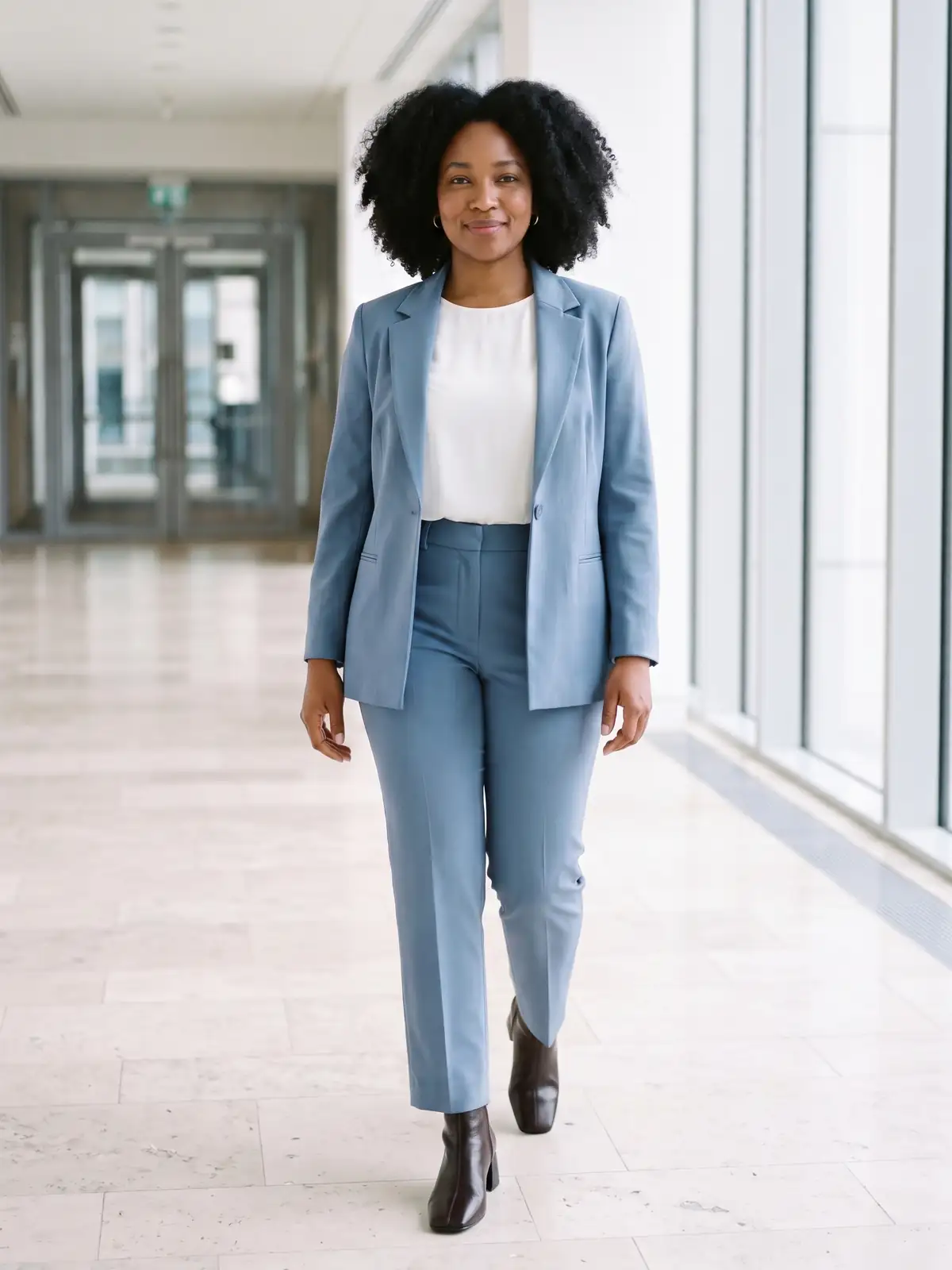
- Zapaka Dusty Blue Notched Lapel One Button Slim Fit Long Women Suit $125 Shop at Zapakaaffiliate link
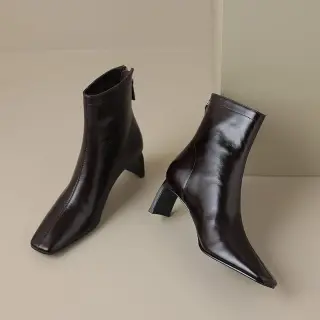 CHIKO Brielle Square Toe Chunky Heels Ankle Boots $138 Shop at CHIKOaffiliate link
- Zapaka Dusty Blue Notched Lapel One Button Slim Fit Long Women Suit $125 Shop at Zapakaaffiliate link
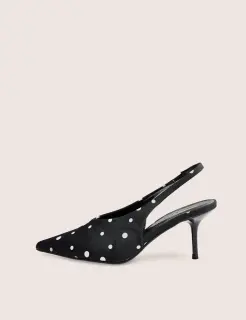 Public Desire UK Brooke Black Polka Dot Court Mid Heels £27.99 Shop at Public Desireaffiliate link
4. Ankle boots
On the left: CHIKO's Brielle boots in dark brown leather with a square toe and a block heel (US$138). Under trousers, an ankle boot looks like a shoe with more coverage, which makes it the simplest winter answer. Corporette's guide to office boots says dress codes have relaxed to the point that the question is now which style, not whether. Its old rule for conservative offices still tells you which style is safest: "the boot should be as close to plain leather as possible." No buckles, no contrast heel, no cowboy shapes. Over-the-knee boots are the exception; the same page says they "were always controversial for the office". More outfits are in our guide to how to wear ankle boots.
5. Slingbacks
On the right: Public Desire's Brooke slingbacks, black with white polka dots, on a slim mid heel (£28). The toe is closed and the heel is open, which is why they sit one row below pumps in the table. The University of Pittsburgh's career office lists them by name for business casual: "Flats, sling-backs, boots, non-athletic shoes". WSS lists "Kitten Heeled Sling Backs" among its best business casual shoes. The pattern is the debatable part: Charles & Keith advises against "loud patterns (e.g. animal prints, polka dots, stripes)". A small dot on a black shoe is about as quiet as a pattern gets, but in a conservative office choose the plain version.
- Zapaka Dusty Blue Notched Lapel One Button Slim Fit Long Women Suit $125 Shop at Zapakaaffiliate link
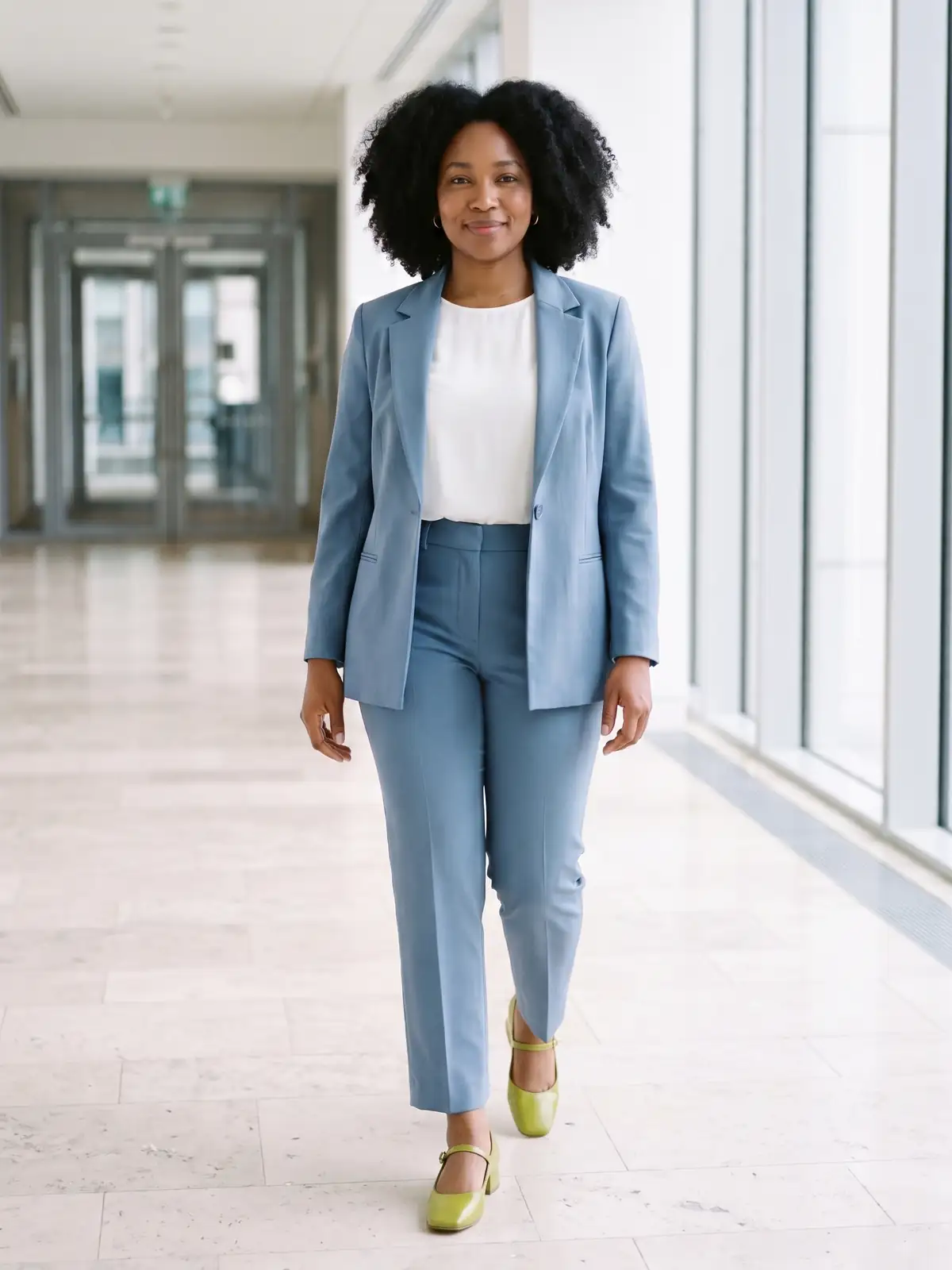
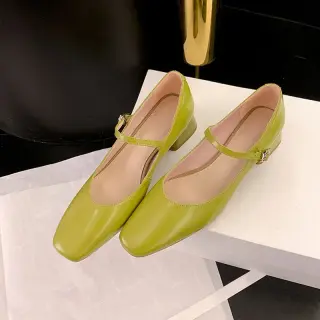 CHIKO Dedra Square Toe Block Heels Mary Jane Shoes $108 Shop at CHIKOaffiliate link
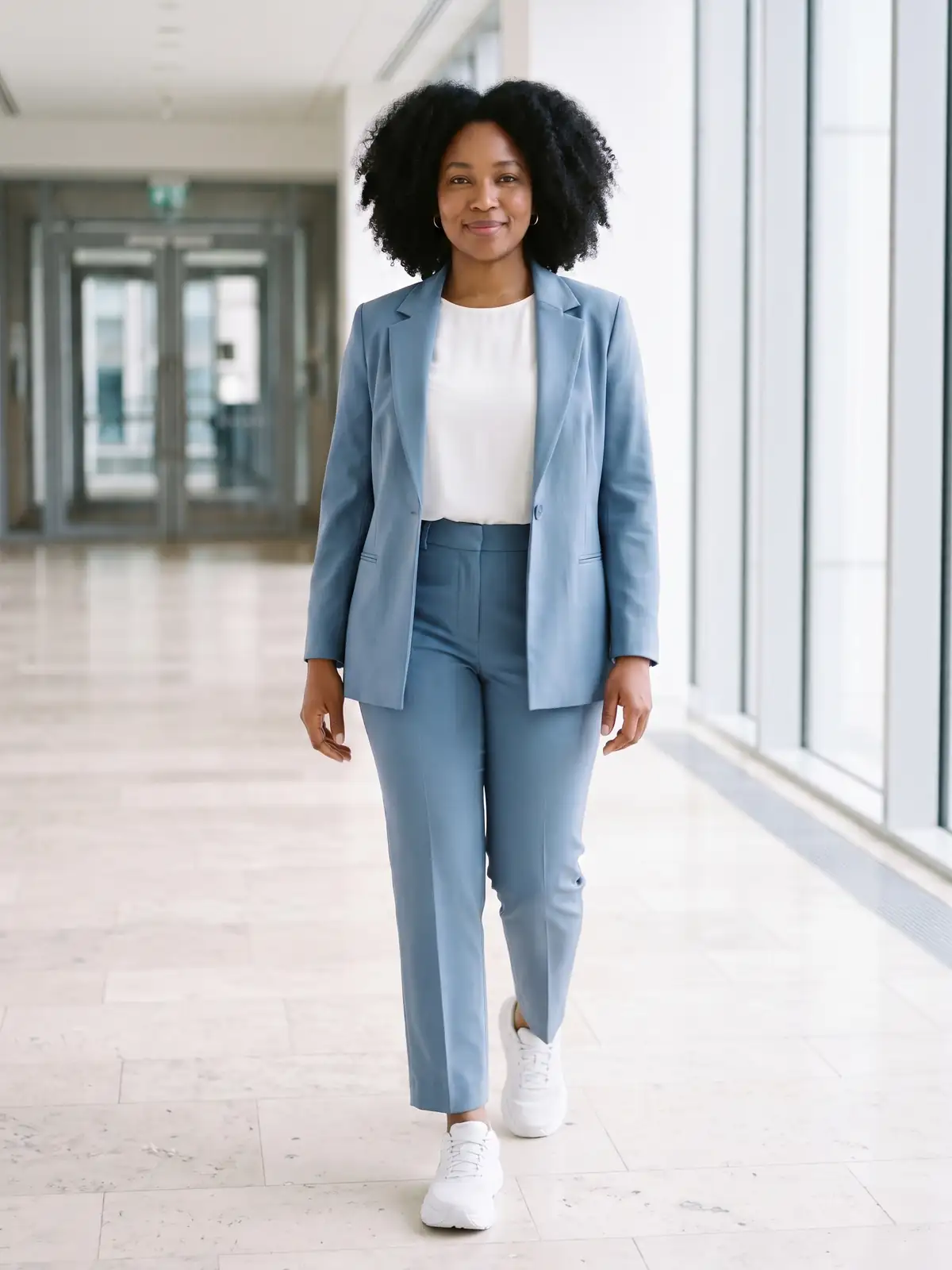
- Zapaka Dusty Blue Notched Lapel One Button Slim Fit Long Women Suit $125 Shop at Zapakaaffiliate link
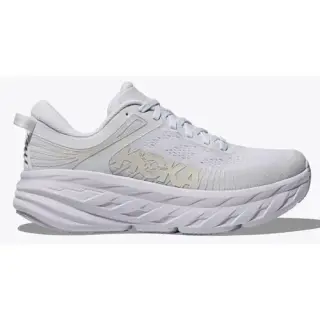 Hoka Bondi 7 Women's White, White $164.99 Shop at eFootwearaffiliate link
6. Mary Janes
On the left: CHIKO's Dedra Mary Janes in lime green with a square toe and a block heel (US$108). The shape is classic, with a closed toe, a strap and a low heel, and WSS files "Flats and Mary Janes" under "Understated, comfortable, and polished". The color is the statement. One bright shoe under a plain suit works in a standard or relaxed office and is exactly what WSS means by "a fun color". In black or burgundy leather the same shoe is fine anywhere.
7. Sneakers
On the right: HOKA's Bondi 7 in all white (US$165), from eFootwear. This is the edge of the code, shown on purpose. It is a running shoe, thick-soled and cushioned, and next to a suit it reads as a choice made for comfort.
Where it passes: offices that already allow sneakers, and commutes everywhere. WSS: "Sneakers were once considered unprofessional for the workplace, but they have now found a place in the business casual sphere, especially in tech and startup industries." Where it does not: Corporette's reminder is short, "Sneakers aren’t appropriate for every office — know yours!"
The shape matters more than the brand. WSS: "Avoid overly sporty sneakers and open-toe shoes." Its advice is "to choose a classic silhouette rather than a too-sporty one". The Washington Post draws the same line with a joke for a heading: "If you can run more than a mile in your sneakers, do that in them instead." What it accepts is "Clean athletic shoes with a flat bottom". By that test a plain white leather sneaker passes more easily than the pair in the picture, and the Bondi is the shoe for the walk to work and for jobs spent standing. Our guides to the best shoes for standing all day and the best walking shoes for women compare those.
Open toes and sandals
This is the real argument, and the numbers show it.
- In YouGov's July 2026 poll of 1,088 American adults, 54 percent said sandals are acceptable for a woman working in an office and 33 percent said they are not. Women were more tolerant than men: 60 percent against 47.
- Randstad's 2019 survey of 1,204 American workers: "40 percent say the same about open-toed shoes of any kind", the same being that they look unprofessional.
Employers and advisers divide the same way.
Open toes are fine: Virginia Tech's career office, on business casual: "Open-toed shoes are considered acceptable." The Washington Post: "it’s fine to show a little toe", provided the nails are tidy. Alison Green of Ask a Manager, answering a reader in 2016, said it depends on the office: dressier sandals are fine in many, and conservative ones expect closed toes.
Closed toes only: Indeed, Luxe Digital and WSS. PrepScholar: "In general, you should avoid open-toe shoes, though if you live in a warmer climate they are more often accepted." Rutgers Business School's one-page guide to business casual says no sandals.
Peep toes are safer than sandals. Kat Griffin of Corporette, on what she would do in charge: "I would just ban all sandals, for both men and women." But she adds: "I think it’s much harder to offend in peep-toes than it is in sandals".
Flip-flops are out everywhere. They head Corporette's list of things "that may be unprofessional even in your laid-back office". Stylist Laurel Pantin, in The Zoe Report, on even the most relaxed creative offices: "I would say avoid flip-flops."
A workable rule for summer: a closed toe with an open back (a slingback or a mule) before an open toe; a peep toe before a sandal; a sandal with a heel strap and a real sole before anything flat and bare. And look at what senior women in your office wear in July.
How high can the heel be?
You do not need one. SEEK: "heels are optional, not a requirement." The Washington Post's rule: "Give yourself permission to give up on heels forever, if you hate them." In the United Kingdom the government's guidance on dress codes says a rule could be unlawful "if it requires female employees to wear high heels".
If you wear one, the medical advice is two inches or less.
| Source | Advice |
|---|---|
| American Podiatric Medical Association | "Heel wearers should avoid heels higher than two inches" |
| American Academy of Orthopaedic Surgeons | A square or wide toe box, "with a heel that is lower than 2 inches high" |
| Harvard Health | Most comfortable: "no higher than three-quarters of an inch" |
| Baylor Scott & White Health | "with a three-inch heel, there is 76% more weight through the ball of the foot" |
The orthopedic surgeons explain the mechanism: "The higher the heel, the greater the pressure and the likelihood for injury." A pointed toe adds to it. Harvard Health adds a point most people get wrong: "It doesn't matter whether the heel is thin and spiky or wide and chunky." A block heel is steadier, not kinder to the forefoot. Height is what counts.
The APMA's 2014 survey of 1,000 American adults found that 49 percent of women wear high heels and that 71 percent of those who do say the shoes hurt. Its past president Matthew Garoufalis also advises against daily wear: "Daily heel-wearing can cause the Achilles tendon, the strong tendon at the back of your ankle, to shrink."
The professional limits are close to the medical ones. Rutgers' career office asks for "closed-toed heels that are no more than 2 inches tall" for professional dress. The University of Pittsburgh allows "low or high heels (not above 4″)". In Randstad's survey half of workers said heels over three inches look unprofessional. The Washington Post: "heels over four inches are better for a party than an office."
Corporette's working definitions: a low heel is two inches and under; a kitten heel is "generally under 1.5″". Shops list the heel height on the product page; check it before you buy.
Fit: two facts worth knowing
From the American Academy of Orthopaedic Surgeons: "Because your feet may swell throughout the day (up to 8%), purchase shoes toward the end of the day to ensure maximum comfort." It also advises leaving about half an inch between your longest toe and the tip of the shoe. A work shoe is worn for eight or nine hours; one that fits at ten in the morning may not at four.
Tights, socks and bare ankles
Hose. Corporette's rule: wear nude pantyhose when "You’re interviewing, you’re in a formal situation (like court), or it’s a big day where you’ll see lots of big wigs." Otherwise bare legs are fine once you have seen someone senior do it. Black opaque tights with loafers, pumps or Mary Janes are business casual all winter; see how to wear tights with dresses.
Socks. With loafers and ankle pants, the choice is a no-show sock for a bare ankle or a fine dark sock. Corporette notes that sheer socks with loafers and Mary Janes are a current look, with a condition: "it can be tricky to pull off unless your pants are full length".
The commute. Corporette's winter advice is to wear weather boots or sneakers to the office and change there. Nobody judges the shoes you arrive in.
Business casual shoes for men
The same logic, with fewer options. Indeed's list (loafers, oxfords, boots) applies to men unchanged. The Emily Post Institute gives the casual limit: in workplaces where suits are not usual, "casual leather shoes or well kept sneakers." Reed, the British recruiter, describes which sneakers: sleek ones, not branded sports trainers.

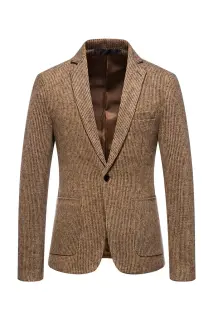 Zapaka Khaki Tweed One Button Notched Lapel Men's Blazer $79 Shop at Zapakaaffiliate link
- Farah Brewer Relaxed Fit Oxford Shirt In Sky Blue £70 no longer sold
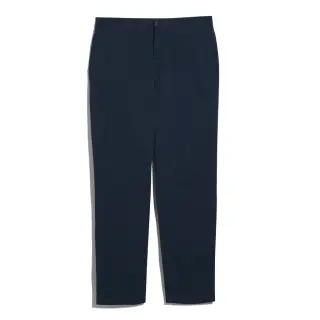 Original Penguin Straight Fit Chinos In Dark Sapphire £56 Shop at Original Penguinaffiliate link
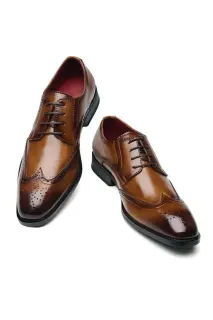 Zapaka Brown Lace-Up Leather Men's Shoes $89 Shop at Zapakaaffiliate link
Brown leather is the men's default: here Zapaka's brown lace-up brogues (US$89) under Original Penguin chinos (£80), with Zapaka's khaki tweed blazer (US$79) and Farah's sky blue oxford shirt (£70). Our guide to business casual for men has the full wardrobe, and what shoes to wear with black pants covers the commonest pairing.
When safety decides
Some workplaces require closed or protective shoes for reasons that have nothing to do with style. The US safety regulation on foot protection, 29 CFR 1910.136, requires employers to ensure protective footwear "when working in areas where there is a danger of foot injuries due to falling or rolling objects, or objects piercing the sole". It does not mention offices or open toes; many employers set their own stricter rule for labs, kitchens, warehouses and clinics. SEEK's advice covers it: "Check the dress code and do not wear footwear that could create a safety risk".
Where the sources disagree
- Open toes. Acceptable for Virginia Tech and The Washington Post; not for Indeed, WSS, PrepScholar or Rutgers Business School. In Randstad's survey 40 percent of workers called them unprofessional.
- Sneakers. Accepted in clean, plain form by The Washington Post, WSS and Charles & Keith (for creative, tech and start-up workplaces). Refused by The Muse, CareerSherpa, Rutgers Business School and the University of Tennessee.
- Heel limit. Two inches for Rutgers and the medical bodies; three-quarters of an inch for comfort, says Harvard Health; four inches as the outer limit for Pittsburgh and The Washington Post.
- Pattern and color. Charles & Keith wants neutral, plain shoes. WSS welcomes "a fun color".
- Mules. A shoe designer quoted by The Zoe Report says the mule rates highest for comfort, and that many people find an open back poor for running around; Charles & Keith says backless shoes lean casual.
The disagreements follow the type of office each source has in mind. Career offices write for interviews and first jobs, so they are strict. Retailers and newspapers write for people already in the job, so they are looser. Start strict and relax as you learn the place. For the clothes, our guide to the business casual dress code shows where the sources disagree on jeans, polos and skirt length.
In the United Kingdom and Australia
Heels and the law. After a petition signed by 152,420 people, the UK government published guidance in May 2018. It says: "A dress code could be unlawful, for example, if it requires female employees to wear high heels, with all the discomfort and inherent health issues these can cause, because it treats women less favourably than men." Its example of a lawful code is a suit "with low-heeled shoes for both sexes."
Vocabulary. A pump is a court shoe in Britain, sneakers are trainers, and a British "pump" is a ballet flat. Reed's list for smart casual offices: "loafers, oxfords, ankle boots, ballet flats or block heels."
The trend. Writing in City AM, Eliza Filby dates the change: "Trainers began outselling high heels in the UK somewhere between 2015 and 2017". She gives no source for the sales figures, so treat it as her reading.
Australia. SEEK is the most relaxed of all the career guides quoted here: "Some workplaces may require enclosed or protective footwear, while others may allow sneakers, sandals or other styles." Its answer to which shoes are not business casual: "There is no universal list of business-casual shoes."
Questions people ask
What shoes are business casual for women?
Loafers, ballet flats, low pumps, oxfords, ankle boots, slingbacks and Mary Janes, in leather or suede. Sandals and sneakers depend on the office.
Are sneakers business casual?
Plain, clean, flat-soled sneakers in leather or suede are accepted in relaxed offices, especially in tech and creative work. Running shoes are not. In a conservative office, no sneaker is.
Are open-toe shoes business casual?
It depends on the employer. About half of Americans accept sandals on a woman at the office, and 40 percent of workers in one survey called open toes unprofessional. A peep toe is safer than a sandal; a closed toe is safest.
Can you wear sandals to a business casual office?
In relaxed offices and warm climates, dressy sandals with a heel strap usually pass. Flip-flops do not pass anywhere.
Do business casual shoes have to have a heel?
No. Flats, loafers and oxfords are fully business casual, and doctors recommend staying under two inches if you do wear a heel.
Are ankle boots business casual?
Yes. Plain leather or suede ankle boots under trousers or with a midi skirt are accepted in nearly every office.
Are Mary Janes professional?
Yes. A closed toe, a strap and a low heel make them one of the safer choices; pick dark leather for a conservative office.
Are mules business casual?
In standard and relaxed offices, yes, with a closed toe. The open back makes them more casual, so skip them for interviews.
What color shoes go with business casual?
Black, brown, tan, navy and burgundy go with nearly everything. A bright or patterned shoe works under a plain outfit in offices that are not conservative.
Sources
- Indeed: What Is Business Casual Attire? (updated November 9, 2026)
- Charles & Keith: Business casual shoes guide
- WSS: Best Business Casual Shoes for Women (November 5, 2025)
- PrepScholar, Samantha Lindsay: The Ultimate Guide to Business Casual for Women (updated August 8, 2024)
- SEEK: Tips on dressing business casual for women (updated September 30, 2026)
- The Washington Post, republished by the University of Arizona: The 39 definitive rules of office fashion (June 17, 2025)
- The Zoe Report, Charlotte Collins: The Best Work Shoes (updated February 20, 2024)
- Cole Haan: Women's loafer style guide
- Corporette: Business Casual for Women, Without Being Overdressed (updated October 28, 2026)
- Corporette: Extremely Comfortable Business Casual Shoes (updated September 8, 2026)
- Corporette: The Best Boots for the Office (updated October 20, 2026)
- Corporette: Flip-Flops, Sandals, and Office Propriety (updated March 30, 2021)
- Corporette: The Best Low Heel Work Shoes (updated September 5, 2025)
- Corporette: The Guide to Pantyhose for Work (updated October 28, 2026)
- Corporette: The best socks for winter work outfits
- Corporette: Winter Business Casual for Women
- Ask a Manager, Alison Green: Are sandals considered business attire? (August 23, 2016)
- YouGov, Jamie Ballard: What Americans say is acceptable to wear to work (September 17, 2026)
- Randstad US: Casual dress is almost always in fashion in today's workplace (August 27, 2019)
- American Podiatric Medical Association: High heels are the biggest culprit of female foot pain (May 19, 2014)
- American Academy of Orthopaedic Surgeons, OrthoInfo: Shoes, finding the right fit
- Harvard Health Publishing: How to find the best shoes for foot pain (November 20, 2024)
- Baylor Scott & White Health: Treatment tips for common high heel problems (September 5, 2021)
- Virginia Tech, Career and Professional Development: Professional dress codes
- University of Pittsburgh, Career Central: Attire guide (June 24, 2025)
- Rutgers, Career Exploration and Success: What on earth should I wear?
- Rutgers Business School: Business casual attire (PDF)
- University of Tennessee, Online Public Speaking Center: Dress for success
- The Emily Post Institute: Business Casual 101
- The Muse, Stacey Lastoe: How to pull off a business casual look at a job interview (updated June 19, 2020)
- CareerSherpa, Hannah Morgan: Business Casual for Women (February 23, 2022)
- Luxe Digital: Business casual for women (updated October 2, 2026)
- OSHA: 29 CFR 1910.136, Foot protection
- UK Government Equalities Office: Dress codes and sex discrimination, what you need to know (May 17, 2018)
- UK Parliament: Petition 129823 on high heels at work
- Reed, Amy Davis: Smart casual dress code guide (March 12, 2025)
- City AM, Eliza Filby: What happened to high heels? (September 30, 2025)
The images in this guide are AI-generated: real garments from our catalogue, shown on our own recurring models and made from the shops' photos of each piece. They are not photographs of real people. Prices are the ones the shops showed on November 21, 2026 and can change. Wear It On Me earns a commission when you buy a garment through an affiliate link in a guide (the links are marked, and it costs you nothing extra); a commission never decides what we recommend. How we make these guides.