Best shoes for standing all day: what helps, what the studies say, and 9 pairs for real jobs
What standing all day does to your feet, the features that help, slip-resistant soles, safety toes, where the experts disagree, and nine pairs, seven brands.
Wear It On Me earns a commission on garments bought through affiliate links in our guides. That never decides what we recommend. Details.
The best shoes for standing all day have a firm heel, real arch support, enough room in the toes and a sole that matches your floor: cushioned for walking, steadier for standing still, slip-resistant where it gets wet. For most people that means a stable, cushioned sneaker such as the HOKA Bondi 9, the Mizuno Wave Rider 29 or the HOKA Arahi 8. For kitchens and wet floors it means a slip-resistant shoe such as the New Balance 608v5 SR or the HOKA Bondi SR, and for building sites, a safety-toe boot.
You are not imagining the problem. The Bureau of Labor Statistics found that in 2025 "civilian workers spent 44.9 percent of the workday sitting and 55.1 percent standing." For waiters it was 98.6%, for construction laborers 89.2%, for retail salespeople 83.0% and for nursing assistants 79.2%. Canada's Centre for Occupational Health and Safety (CCOHS) lists what that does: standing regularly "can cause sore feet, swelling of the legs, varicose veins, general muscular fatigue, low back pain". A NIOSH review of the research found "ample evidence showing that prolonged standing at work leads to adverse health outcomes."
Below: what helps, what the studies say about slip-resistant soles and safety toes, where the experts disagree, and nine pairs shown on our regular models at real jobs. All nine are sold by eFootwear, and each picture has the shop link and the price we last checked under it.

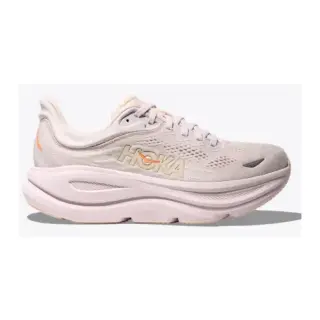 Hoka Bondi 9 Women's Wide D Lilac Cream, Tangerine Glow $174.99 Shop at eFootwearaffiliate link
The HOKA Bondi 9 is the pair I would start with if you mostly stand on hard floors and walk short distances: Fleet Feet calls it "the gold standard for all-day comfort", and one of its testers says "the wide base and cushioning make it a great shoe for walking or standing on your feet all day." It carries the APMA Seal of Acceptance. The pair above is a women's Wide D, $174.99. Its weak points are weight and height; read our Clifton vs Bondi guide if your balance is a concern.
What standing all day does
The numbers vary by study and job, but they point the same way.
- Back. A Danish study cited in the NIOSH review found that standing "more than 30 minutes per hour" roughly doubled the odds of low back pain (odds ratio 2.1). A 2018 meta-analysis of 49 studies found standing more than four hours a day linked to about 31% higher odds of low back symptoms, though its authors call the conclusion "tentative".
- Veins. The same review cites "significantly elevated risks of varicose veins and nocturnal leg cramps in workers standing > 4h/d." CCOHS explains why: standing without walking "causes blood to pool in the legs and feet."
- Feet. Studies of nurses find foot or ankle pain in roughly a quarter to a half of them, depending on the survey, and "a low level of shoe comfort" keeps showing up as a risk factor. In an auto plant, plantar fasciitis risk rose with "increasing time spent standing on hard surfaces".
CCOHS adds a fair line of its own: standing "by itself poses no particular health hazard." It is standing still for hours, on hard floors, in the wrong shoes, that does it.
What to look for in a shoe
CCOHS's checklist is short and specific:
| Feature | What CCOHS says |
|---|---|
| Heel | "DO choose shoes that provide a firm grip for the heel." |
| Arch | "DO ensure that shoes have arch supports." |
| Toes | "Pain and fatigue result if shoes are too narrow or too shallow." |
| Cushioning | "DO NOT wear shoes that lack arch support or cushioning." |
| Hard floors | "DO use a shock-absorbing cushioned insole when working on metal or cement floors." |
| Heel height | "A small heel can decrease strain on the Achilles tendon" |
| Fastening | "DO wear shoes with lace-up fastenings." |
Dr. Najwa Javed, a podiatrist quoted by Shop TODAY, adds: "A firm heel counter keeps the heel stable and reduces foot movement inside the shoe". She also warns that "Overly flexible shoes can lead to arch collapse and strain." For fit, our walking shoe guide has the podiatrists' three-step store test; the same rules apply here, and CCOHS adds: "Try on new boots around midday. Feet normally swell during the day."
Slip-resistant shoes: the best evidence in this guide
If you work in a kitchen, a hospital or anywhere the floor gets wet, this section matters more than cushioning.
Researchers at the Liberty Mutual Research Institute for Safety followed 475 workers in 36 fast-food restaurants for up to 12 weeks. They found that "the use of slip-resistant shoes was associated with a 54% reduction in the reported rate of slipping." A follow-up found that "Provision of slip-resistant shoes was the strongest predictor of their use", and the authors concluded: "employers should consider providing slip-resistant shoes at work."
A NIOSH trial across 226 school districts then gave food-service workers slip-resistant shoes at no cost. Slip injuries in that group fell "from a baseline measure of 3.54 slipping injuries per 10 000 worker-months to 1.18", while the comparison group's rate did not fall.
What the label means: since 2021 the US has a specification, ASTM F3445, that uses the F2913 lab test on a whole shoe. SATRA, a footwear testing body, explains that the "SR" level needs a friction score of 0.40 on wet and dry tile, and a newer "SRO" level adds "oily wet" floors at 0.33. Not every shoe sold as slip-resistant says which test it passed; the restaurant study simply counted soles with a "slip-resistant" marking. If your employer requires slip-resistant shoes, look for F2913, SR or SRO on the label or ask the shop. Of the nine pairs below, three are sold as slip-resistant: the New Balance 608v5 SR, the HOKA Bondi SR and the Timberland PRO boot. The running shoes are not.
Safety toes and work boots
OSHA requires protective footwear where objects can fall, roll or pierce the sole, and points to the ASTM F2413 standard. A safety toe that passes F2413 withstands "a 75 ft-lbf impact" and "2,500 lbf" of compression, whatever it is made of: WC Safety, a safety-footwear retailer, notes that "steel, alloy, and composite caps all meet the same 75 ft-lbf impact" rating. The differences are weight and feel. Thorogood, a boot maker, says alloy toes give "good impact protection but with a lighter weight" than steel, though, being metal, they are not ideal for "electrical work, extreme temperatures".
Work boots do cost some comfort. In a 2026 lab study, 20 young adults stood for two hours, and "foot discomfort was 46 ± 4% greater" in occupational footwear than in athletic shoes. If your job does not require a safety toe or a boot, a sneaker is likely the more comfortable choice.
Where the experts disagree
| Question | One side | The other side |
|---|---|---|
| Soft or firm soles? | "Look for thick, shock-absorbing soles and insoles to prevent joint fatigue" (Dr. Najwa Javed, podiatrist) | "hard soles for standing and soft soles for walking" (a 2026 systematic review of 26 studies) |
| Zero-drop shoes? | Dr. Anne Holland Johnson, an HSS foot and ankle surgeon, says "no major heel drop" is best for most walkers | "A small heel can decrease strain on the Achilles tendon" (CCOHS); people with Achilles problems "should avoid zero drop" until healed (Dr. Tom Biernacki, DPM) |
| Custom orthotics? | Custom or store-bought insoles "provide added support" (Dr. Javed) | For heel pain, "A comparison of customised and prefabricated foot orthoses showed no difference" (British Journal of Sports Medicine meta-analysis, 2018) |
| Compression socks? | In a trial with 12-hour shifts, standing workers "may benefit from 15-20 or 20-30 mmHg compression stockings"; a hairdresser trial found no end-of-day swelling with them | NIOSH's review warns that "some support hose may actually be more harmful than helpful if they restrict lower leg venous return" |
| Mat or shoes? | "An anti-fatigue floor mat can provide an extra layer of separation between your feet and a hard floor" (Cleveland Clinic) | Mats do "not eliminate sore feet by itself" (CCOHS); one study found no difference between a mat and insoles |
| Clogs or sneakers? | Clogs "are traditionally worn by professionals who stand all day" (Dr. Saylee Tulpule, podiatrist, HuffPost) | CCOHS prefers lace-ups with a firm heel grip; with a loose heel, "toes tend to grip which can lead to tendinitis" (Dr. Megan Leahy, on foam clogs) |
My reading: the soft-or-firm question depends on how much you walk. Servers and nurses walk miles in a shift and do well in cushioned running shoes; cashiers, hairdressers and pharmacists mostly stand in one spot, where a steadier, firmer shoe and a good mat may help more than extra foam. On compression, a meta-analysis of 11 trials supports light 10 to 20 mmHg socks; check with a doctor first if you have vein or circulation problems.
Three habits with evidence behind them
Rotate two pairs. In the auto plant study, "Rotation of shoes during the work week was found to reduce the risk of presenting with plantar fasciitis." It was an observational study, but it costs nothing to try.
Try an off-the-shelf insole before a custom one. In a 1988 study of 96 women who stood at work, cushioned insoles brought "significant reductions in back pain", foot and leg pain, though 25 of them found the insoles made their shoes too tight. A Cochrane review found "strong evidence that the use of insoles does not prevent back pain", so expect comfort, not a cure.
Move. CCOHS recommends changing position often and using "a foot rail or portable footrest to shift body weight". Cleveland Clinic's Dr. Christina Schilero suggests calf stretches through the day, "holding the stretch for 30 seconds on each side."
For kitchens and wet floors

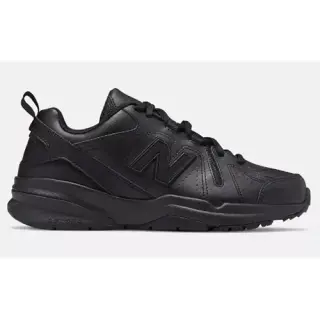 New Balance 608v5 Classic Trainer Women's Slip Resistant Black $60 Shop at eFootwearaffiliate link

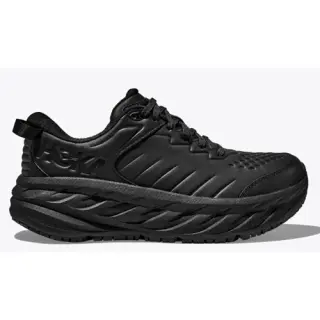 Hoka Bondi SR Men's Black, Black $179.99 Shop at eFootwearaffiliate link
The New Balance 608v5 Slip Resistant ($60) is the budget work shoe: a leather upper, ABZORB cushioning, a rubber outsole, and widths from narrow to wide. It is heavy and firm; RunRepeat measured the regular 608v5 at 13.6 oz and warned that "if you're looking for a light pair of shoes to walk around, this ain't it!" Zappos lists no specific slip test for it, so check with New Balance or your employer if a standard is required. Customers in restaurants rate it well; one calls it the "best non slips I've had in years for restaurant industry".
The HOKA Bondi SR ($179.99) is the comfortable, expensive option: a leather Bondi with a slip-resistant sole. OutdoorGearLab's editors write that "For an 8+ hour shift, we'd be happy to wear these Hokas", and that "For potentially messy places like wet hospital floors or greasy kitchens, these Bondis will work to keep you upright." Their cons: "Heavy" and "Low breathability", and they can feel "a bit tight and restrictive on your foot when brand new." It weighs about 14 oz per shoe; I found no slip test standard named on the pages I read.
For salons, pharmacies and shop floors

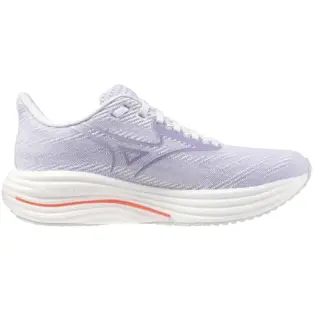 Mizuno Wave Rider 29 Women's Running Shoe White, Icelandic Blue $99.99 Shop at eFootwearaffiliate link

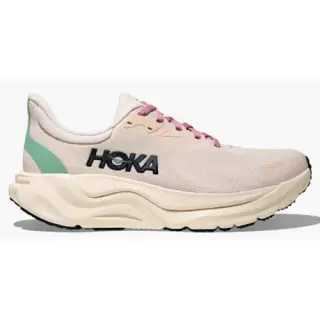 Hoka Arahi 8 Women's Rose Cream, Alabaster $96.99 Shop at eFootwearaffiliate link
The Mizuno Wave Rider 29 ($99.99) is the light, everyday option, at about 8 oz in a women's size. Doctors of Running, whose reviewer is a physical therapist, answers "Is This a Good Shoe for Standing: Yes" and finds the fit "normal to slightly wider". It is a neutral shoe; the same reviewer says that "Those with stability needs should definitely look at the Wave Inspire". Our gym outfits for men guide shows the men's version on a treadmill.
The HOKA Arahi 8 ($119.99) is for people who want more support: a stability shoe built on HOKA's H-Frame, and on APMA's seal list. Doctors of Running again says "Standing: Yes", OutdoorGearLab found it "feels planted and stable", and RunRepeat calls it "Comfy and plush for everyday use". Reviewers disagree on durability and width, and RunRepeat warns it is "a bit underwhelming on wet surfaces", so it is a shoe for dry floors. It is also the first pick in our flat-feet running shoe guide.
For classrooms and galleries

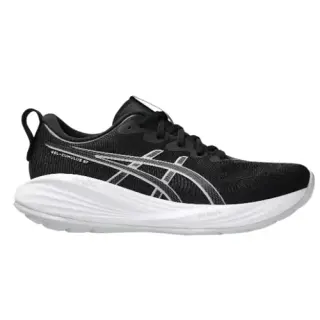 Asics Women's Gel-Cumulus 27 Running Shoes Black/Concrete $79.99 Shop at eFootwearaffiliate link

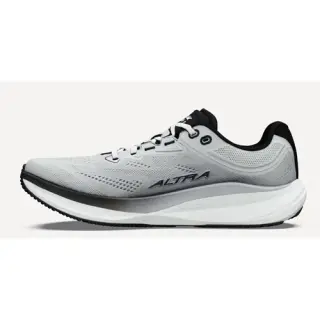 Altra Torin 9 Men's Running Shoe Ultimate Grey, Black, Grey $159.99 Shop at eFootwearaffiliate link
The ASICS Gel-Cumulus 27 ($79.99) is the value pick: neutral, about 8 oz in a women's size, and listed by RunRepeat for "Walking | All-day wear". Its outsole wears quickly, and ASICS has since released the Cumulus 28, so the 27 is now the cheaper older model.
The Altra Torin 9 ($159.99) is the zero-drop option: the heel and forefoot sit at the same height, on a moderate 28 mm of foam. Doctors of Running says "Standing: Yes", and RunRepeat recommends it to people who "Want a zero-drop shoe for daily runs, walking, or all-day wear." Two cautions: Dr. Biernacki says zero drop suits people who have "fully transitioned", and the Doctors of Running reviewer found a "Low volume toe box" that did not give "the comfortable Altra toe box fit of the past." If you have never worn zero drop, wear it for part of a shift at first.
For building sites and stockrooms
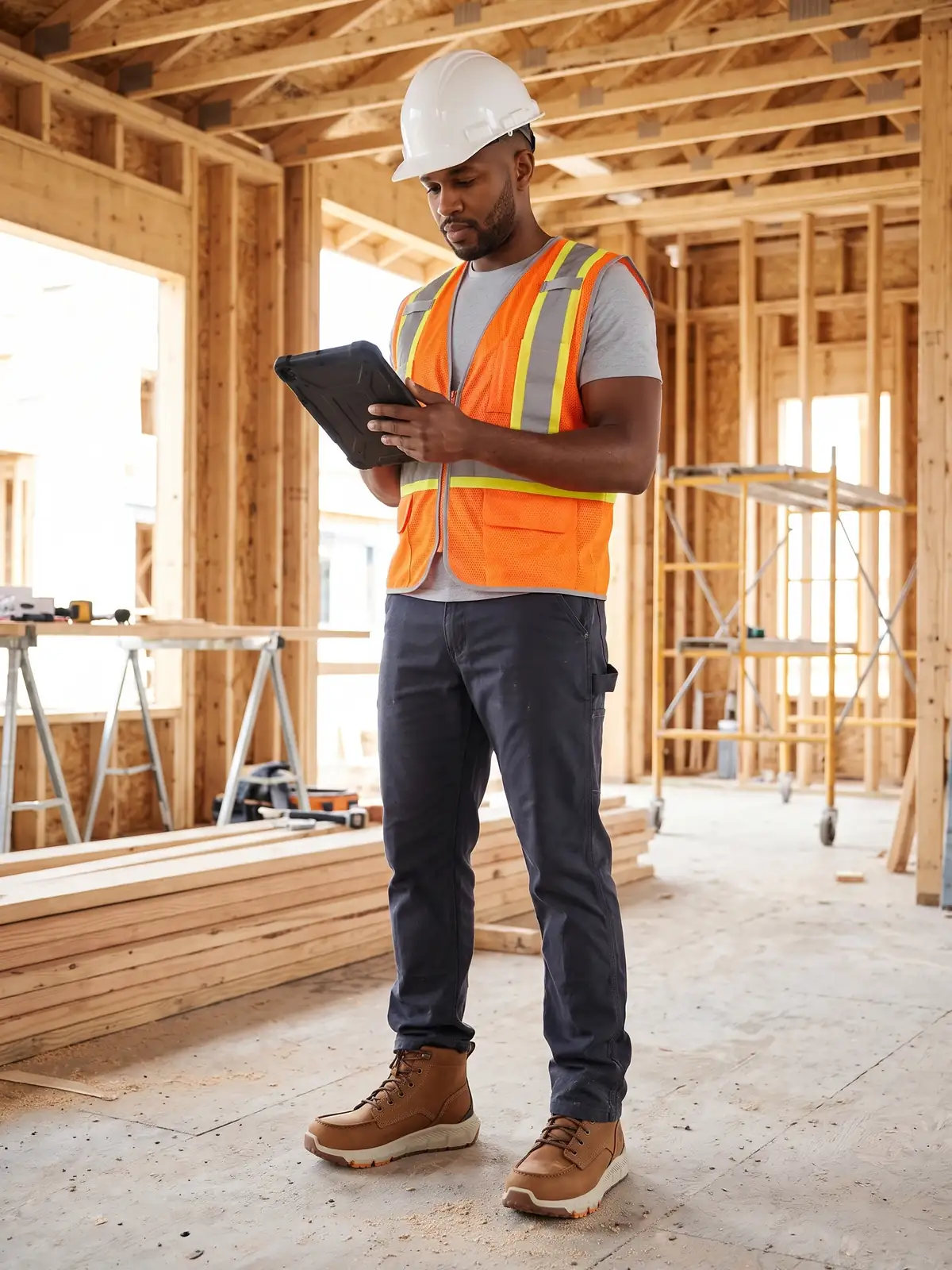
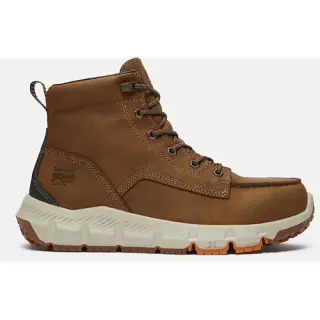 Timberland Men's Timberland PRO® Tempe Moc Toe 6" Alloy Toe Work Boot Light Brown Full-Grain $159.99 Shop at eFootwearaffiliate link
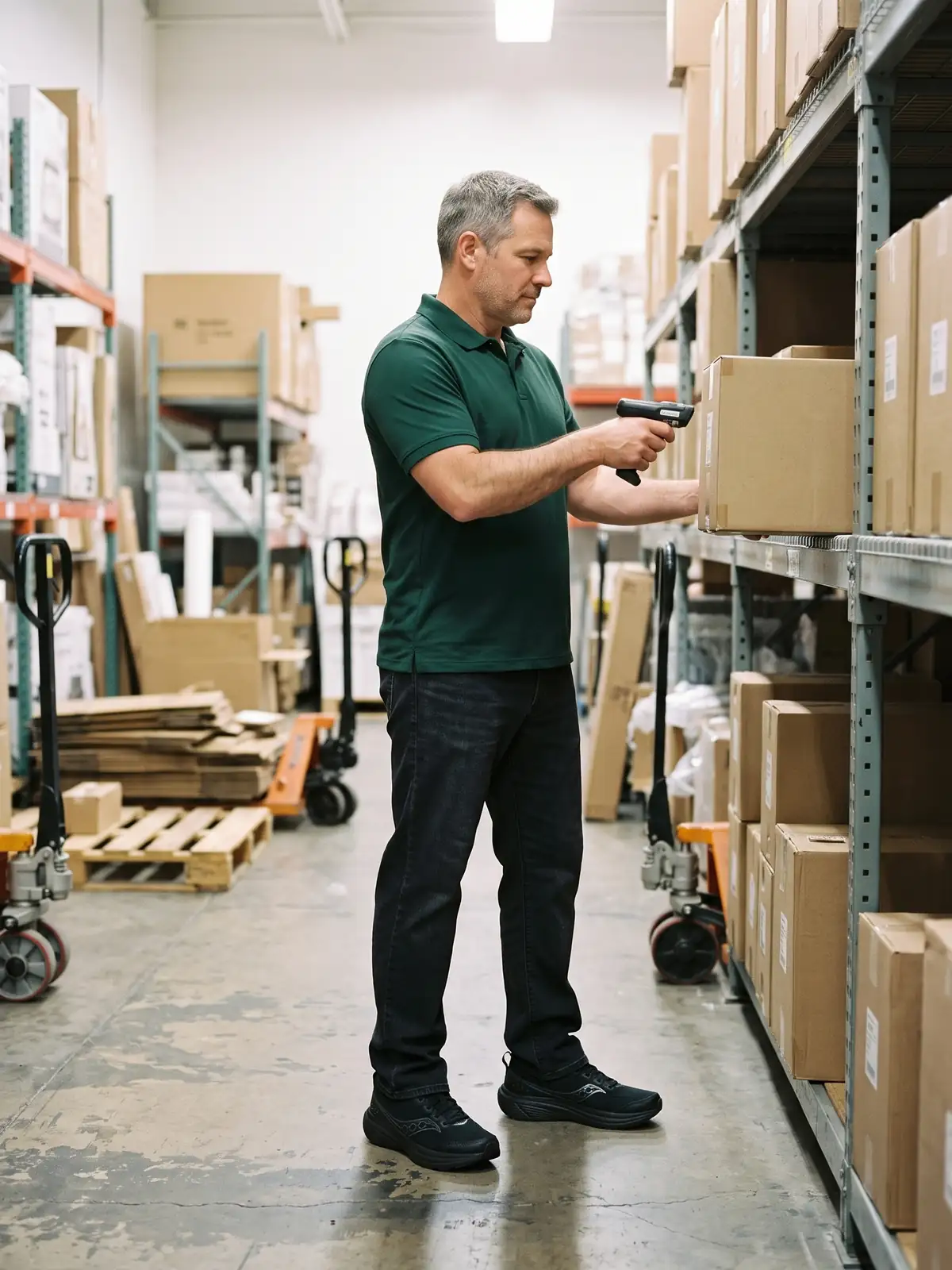
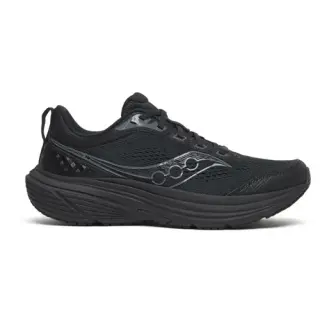 Saucony Cohesion 19 Men's Triple Black $69.99 Shop at eFootwearaffiliate link
The Timberland PRO Tempe moc toe boot ($159.99) has an alloy safety toe in a full-grain leather 6-inch boot. Timberland's waterproof version of the Tempe is listed with an outsole "tested to F2913" for slip resistance; check the label on the version you buy if your site requires a particular rating. I found no independent editor review of it, and customer reviews are split: one calls it "One of the most comfortable boots I have had", another says there "Felt like there was zero padding between you and the floor." If you stand on concrete in it, add a cushioned insole, as CCOHS advises for "metal or cement floors".
The Saucony Cohesion 19 ($69.99) is the budget sneaker for stockrooms and shop floors without safety rules. RTINGS found an "Impressively secure platform is easy to trust", but "Forefoot shock absorption is sub-par overall", so pair it with a mat if you stand in one spot.
The nine pairs side by side
| Shoe | Best for | Slip-resistant | Notes | Price |
|---|---|---|---|---|
| HOKA Bondi 9 (women's Wide D) | Long days on hard floors | No | Max cushion, APMA seal, heavy | $174.99 |
| New Balance 608v5 SR (women's) | Restaurants, budget | Sold as SR | Leather, heavy, narrow to wide | $60 |
| HOKA Bondi SR (men's) | Kitchens, hospitals | Yes | Leather, about 14 oz | $179.99 |
| Mizuno Wave Rider 29 (women's) | Salons, retail | No | Light, neutral | $99.99 |
| HOKA Arahi 8 (women's) | Support for flat feet | No | Stability, APMA seal | $119.99 |
| ASICS Gel-Cumulus 27 (women's) | Teachers, value | No | Older model, outsole wears | $79.99 |
| Altra Torin 9 (men's) | Zero-drop fans | No | Ease into it | $159.99 |
| Timberland PRO Tempe (men's) | Building sites | Check the label | Alloy safety toe | $159.99 |
| Saucony Cohesion 19 (men's) | Stockrooms, budget | No | Firm forefoot | $69.99 |
Prices are eFootwear's on the day we checked, for the model and colour shown. APMA seals are as listed on November 5, 2026.
What I wouldn't do
Wear running shoes on a wet kitchen floor. None of the running shoes here is sold as slip-resistant, and the restaurant studies are clear about what slip-resistant soles do.
Stand all day on a thick, soft mat. CCOHS says "Too much cushioning can cause fatigue and increase the hazard of tripping."
Keep one pair forever. Guidance for walking shoes runs from 300 to 800 miles, or six months to a year; on your feet all day, that comes round fast. Replace them when the heel collapses under your thumb or the sole is worn smooth.
Questions people ask
What shoes do podiatrists recommend for standing all day?
Shoes with a firm heel, arch support, room for the toes and cushioning, laced up. Many recommend stable cushioned sneakers such as HOKA, Mizuno or ASICS models; for wet floors, a slip-resistant pair.
Are HOKAs good for standing all day?
Many people find them so. Fleet Feet calls the Bondi 9 "the gold standard for all-day comfort", and Doctors of Running rates the Arahi 8 good for standing. The Bondi's height is not for everyone; try it first if your balance is a concern.
Are slip-resistant shoes worth it?
Yes, if your floor gets wet or greasy. Restaurant workers in slip-resistant shoes reported 54% fewer slips, and a NIOSH trial saw slip injuries fall by about two-thirds.
Do compression socks help if you stand all day?
Trials in standing workers, including security guards and hairdressers, found less leg swelling with light compression. Start light, around 15 to 20 mmHg, and ask a doctor if you have circulation problems.
Are clogs better than sneakers for standing?
Some nurses and chefs swear by clogs. Workplace-safety guidance prefers lace-ups with a firm heel grip, because a loose heel makes your toes grip. Try both if you can; the best shoe is the one that still feels good at the end of a shift. Our guide to shoes for nurses on long shifts sets out the clogs-or-sneakers debate in more detail.
How often should I replace shoes I stand in all day?
There is no work-specific rule. Walking-shoe guidance runs from 300 to 800 miles or six months to a year. Replace them sooner if the heel collapses or the sole is worn smooth.
Sources
- Sitting and standing, Occupational Requirements Survey, Bureau of Labor Statistics
- Waiters and waitresses, Occupational Requirements Survey, BLS
- Retail salespersons, Occupational Requirements Survey, BLS
- Nursing assistants, Occupational Requirements Survey, BLS
- Working in a standing position, CCOHS
- Safety footwear, CCOHS
- Anti-fatigue mats, CCOHS
- Health risks of prolonged standing at work, Waters and Dick, NIOSH (Rehabilitation Nursing, 2015)
- Occupational standing and musculoskeletal symptoms, a meta-analysis (British Journal of Sports Medicine, 2018)
- Foot and ankle pain among nurses in Japan (Journal of Occupational Health, 2018)
- Risk factors for plantar fasciitis among assembly plant workers (PM&R, 2010)
- Footwear and comfort in prolonged standing, a systematic review (Safety and Health at Work, 2026)
- Prolonged standing in occupational footwear (Ergonomics, 2026)
- Shoe insoles in the workplace (Orthopedics, 1988)
- Insoles for prevention and treatment of back pain, Cochrane review
- Foot orthoses for plantar heel pain, a meta-analysis (British Journal of Sports Medicine, 2018)
- Compression therapy for occupational leg symptoms, a meta-analysis (European Journal of Vascular and Endovascular Surgery, 2008)
- Compression stockings during prolonged standing work (Human Factors, 2023)
- Compression stockings for hairdressers (Jornal Vascular Brasileiro, 2020)
- Floor surface, shoes and slipping in restaurant workers (Occupational and Environmental Medicine, 2011)
- Factors associated with use of slip-resistant shoes (Injury Prevention, 2012)
- Slip-resistant footwear program for food service workers, a cluster randomized trial, NIOSH (2019)
- ASTM F2913 update, SATRA
- A new standard in slip-resistant safety footwear, Occupational Health & Safety
- Foot protection, 29 CFR 1910.136, OSHA
- ASTM F2413 safety footwear explained, WC Safety
- Composite toe vs steel toe work boots, Thorogood
- The best shoes for standing all day, according to experts, Shop TODAY
- How to stop foot pain from standing all day, Cleveland Clinic
- Best clog shoes, according to podiatrists, HuffPost
- Wearing Crocs can be terrible for your feet, Fox13
- Altra zero drop, a podiatrist's review, Balance Foot & Ankle
- The best shoes for standing all day, Fleet Feet
- HOKA Bondi SR men's review, OutdoorGearLab
- New Balance 608v5 review, RunRepeat
- New Balance 608v5 Slip Resistant, Zappos
- Mizuno Wave Rider 29 review, Doctors of Running
- HOKA Arahi 8 review, Doctors of Running
- HOKA Arahi 8 review, RunRepeat
- HOKA Arahi 8 review, OutdoorGearLab
- ASICS Gel-Cumulus 27 review, RunRepeat
- Altra Torin 9 review, RunRepeat
- Altra Torin 9 review, Doctors of Running
- Timberland PRO Tempe alloy toe waterproof boots, Zappos
- Saucony Cohesion 19 review, RTINGS
- APMA Seal of Acceptance database
The images in this guide are AI-generated: real garments from our catalogue, shown on our own recurring models and made from the shops' photos of each piece. They are not photographs of real people. Prices are the ones the shops showed on November 21, 2026 and can change. Wear It On Me earns a commission when you buy a garment through an affiliate link in a guide (the links are marked, and it costs you nothing extra); a commission never decides what we recommend. How we make these guides.