White tie attire: what it means for men and women, and where it is still worn
White tie means a tailcoat, white waistcoat, wing-collar shirt and white bow tie for men, and a floor-length gown for women. The rules, the events, the costs.
Wear It On Me earns a commission on garments bought through affiliate links in our guides. That never decides what we recommend. Details.
White tie means the full evening uniform of the nineteenth century, kept almost unchanged: for men a black tailcoat with tails to the knee, a white waistcoat, a white wing-collar shirt and a white bow tie; for women a gown that reaches the floor. The Emily Post Institute, the American etiquette authority, says white tie "is considered the most formal of all dress codes." Debrett's, its British counterpart, puts the change in perspective: "only a couple of generations ago white tie was standard evening dress and black tie was considered informal." Today it is rare, and the rules are strict enough that organizers still print them. This guide lists every piece, shows four outfits, and quotes the events that still ask for it.
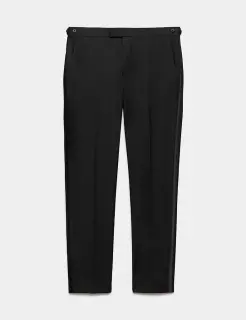 M&S Mens M&S Slim Fit Stretch Tuxedo Trousers, Black CA$109 Shop at M&Saffiliate link
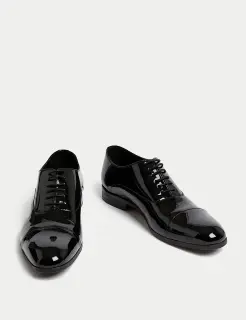 Autograph Mens Autograph Patent Oxford Toecap Shoes, Black CA$235 Shop at M&Saffiliate link
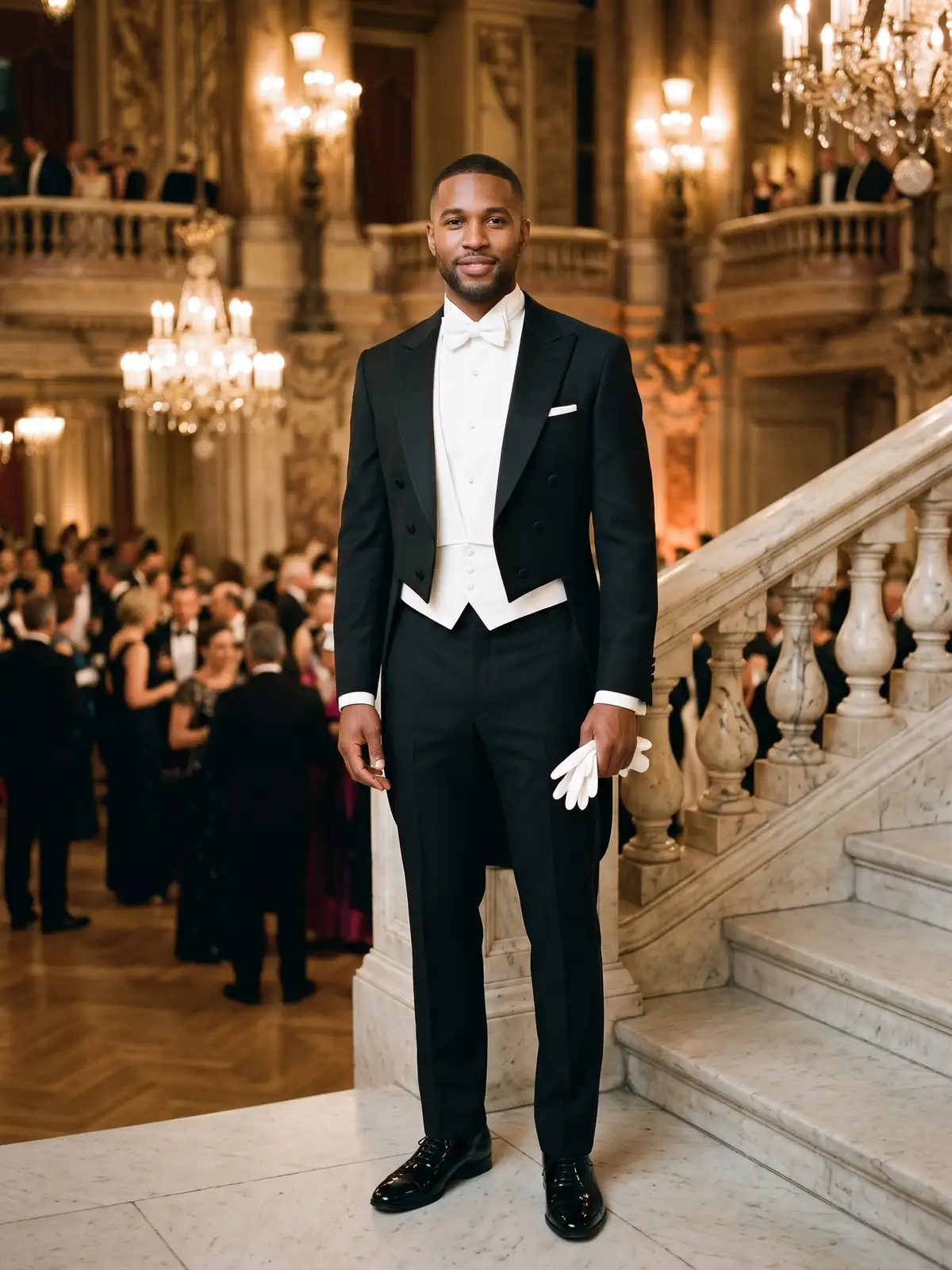
The first picture is the men's uniform, worn correctly: the tailcoat open, the white waistcoat ending just above the coat's front edge, the wing collar, the white bow tie, and black patent oxfords. The trousers are M&S's slim fit stretch tuxedo trousers in black (CA$109), which carry one satin stripe down each leg. That matches the American convention; British and European hosts expect two. The shoes are Autograph's patent oxford toecap shoes from M&S (CA$235). The tailcoat, waistcoat, shirt and tie are described, not sold: they are specialist pieces, and we cover where to rent or buy them below.
What white tie means
White tie is the top of the ladder of Western dress codes, above black tie. Wikipedia's article calls it the most formal evening dress code and gives its other names, full evening dress and dress suit. In Britain and the Commonwealth, the invitation often says "Evening Dress" instead, sometimes followed by "Decorations" (more on that below).
Three things make white tie what it is:
- The tailcoat. A short front cut away at the waist and two tails behind. It is not a tuxedo with tails. Gentleman's Gazette: "A tailcoat is no more a tuxedo than a pocket watch is a wristwatch."
- Everything white at the neck and waist. White waistcoat, white bow tie, white shirt with a stiff front. In black tie these are black.
- The floor-length gown. Black tie lets women choose a cocktail length in many countries. White tie does not.
It is an evening code. Hockerty's tailcoat page says the tailcoat is worn "usually after 6 PM", and none of the etiquette sources we read place white tie in the daytime. The formal day equivalent is morning dress.
What men wear: the checklist
| Piece | What it is | The common mistake |
|---|---|---|
| Evening tailcoat | Black (or midnight blue), silk-faced peaked lapels, cut away at the waist in front, tails to the back of the knee | Buttoning it. It is cut to stay open |
| Trousers | Same cloth, high-waisted, held by braces, no cuffs, a silk stripe down each leg | A belt; a low rise that lets the shirt show |
| Shirt | White, with a stiff piqué or starched front, a wing collar, studs instead of buttons | A soft turndown collar, which belongs to black tie |
| Waistcoat | White piqué (marcella), low-cut | Too long: it must not show below the coat's front |
| Bow tie | White piqué, ideally self-tied | A black tie, or a white necktie |
| Shoes and socks | Black patent oxfords or opera pumps; black silk socks | Matte shoes, slippers, white soles |
| Optional | White gloves, white silk scarf, evening overcoat, pocket watch, white pocket square, carnation boutonnière | A wristwatch |
The Emily Post Institute's list is the short American version: "Black dress coat (tailcoat), matching trousers with a single stripe of satin or braid in the US; two stripes in Europe or the UK", a "White piqué wing-collared shirt with stiff front", "Braces, to ensure a good fit", "Shirt studs and cuff links", "White vest", "White bow tie", "White or gray gloves" and "Black patent shoes and black dress socks".
Debrett's gives the British one: "a black single-breasted tailcoat, with silk lapels, worn unbuttoned, with matching black trousers, with two lines of braid down the outside of the trouser legs." The shirt is "fastened with studs not buttons, with a detachable wing collar and a thin white bow tie."
The waistcoat. This is the detail that separates a correct outfit from a costume. Gentleman's Gazette: "Probably the most common mistake among men who wear white tie for the first time is the fact that the waistcoat is too long." The cure is high-waisted trousers and a short waistcoat, so that no shirt shows between them and no white shows below the coat. The Black Tux puts the rule in one sentence: "The waistcoat must cover the waistband but not extend below the jacket front."
The coat stays open. Gentleman's Gazette explains that the evening tailcoat is "cut so that it cannot be closed or buttoned", which is also why a rented one rarely fits as well as it should. The Black Tux: "The tailcoat should never be buttoned closed."
Color. Black, or midnight blue, which Gentleman's Gazette calls "a correct and striking alternative since the 1920s". The lapel facings are satin or grosgrain. The same source notes that satin is "much more common in North America", while Britain often prefers the duller grosgrain.
Shoes. Patent leather, always. Gentleman's Gazette allows patent opera pumps with a bow or plain patent oxfords or derbies: "These are the only appropriate footwear options for white tie." The Vienna Opera Ball lists "black patent leather shoes" as part of its code. The same patent shoes serve black tie; we compare them in what shoes to wear with a dinner suit.
Gloves. White kid or cotton gloves are traditional for men, but rarely needed now outside balls and royal events. Gentleman's Gazette's rule if you wear them: "remove your gloves when refreshments are served".
What women wear: the checklist
- A floor-length gown. This is the one rule every source agrees on. The Knot: "A white-tie dress is always floor-length". Vogue adds that "midi and tea-length styles are out, as are sleek jumpsuits and coordinated separates."
- Any color, within reason. The Nobel Foundation says of the banquet gowns: "There are no restrictions to color and design, or even taste." The Vienna Opera Ball says "any color is allowed". Vogue's guide to white-tie wedding guest dresses: "White tie is strict with silhouette but generous with palette." At a wedding, leave white and ivory to the bride; at a debutante ball, to the debutantes.
- Rich fabrics. Vogue suggests duchesse satin, silk faille, heavy crepe, brocade, satin and velvet.
- Gloves, optional. Debrett's: "Long gloves may be worn with sleeveless dresses." Vogue: "Evening gloves are also welcome, but not required."
- Jewelry, and perhaps a tiara. One statement piece rather than many, says Vogue. Tiaras belong to white tie (see below).
- A small evening bag and a wrap. A clutch, and a shawl or an evening coat for the walk in.
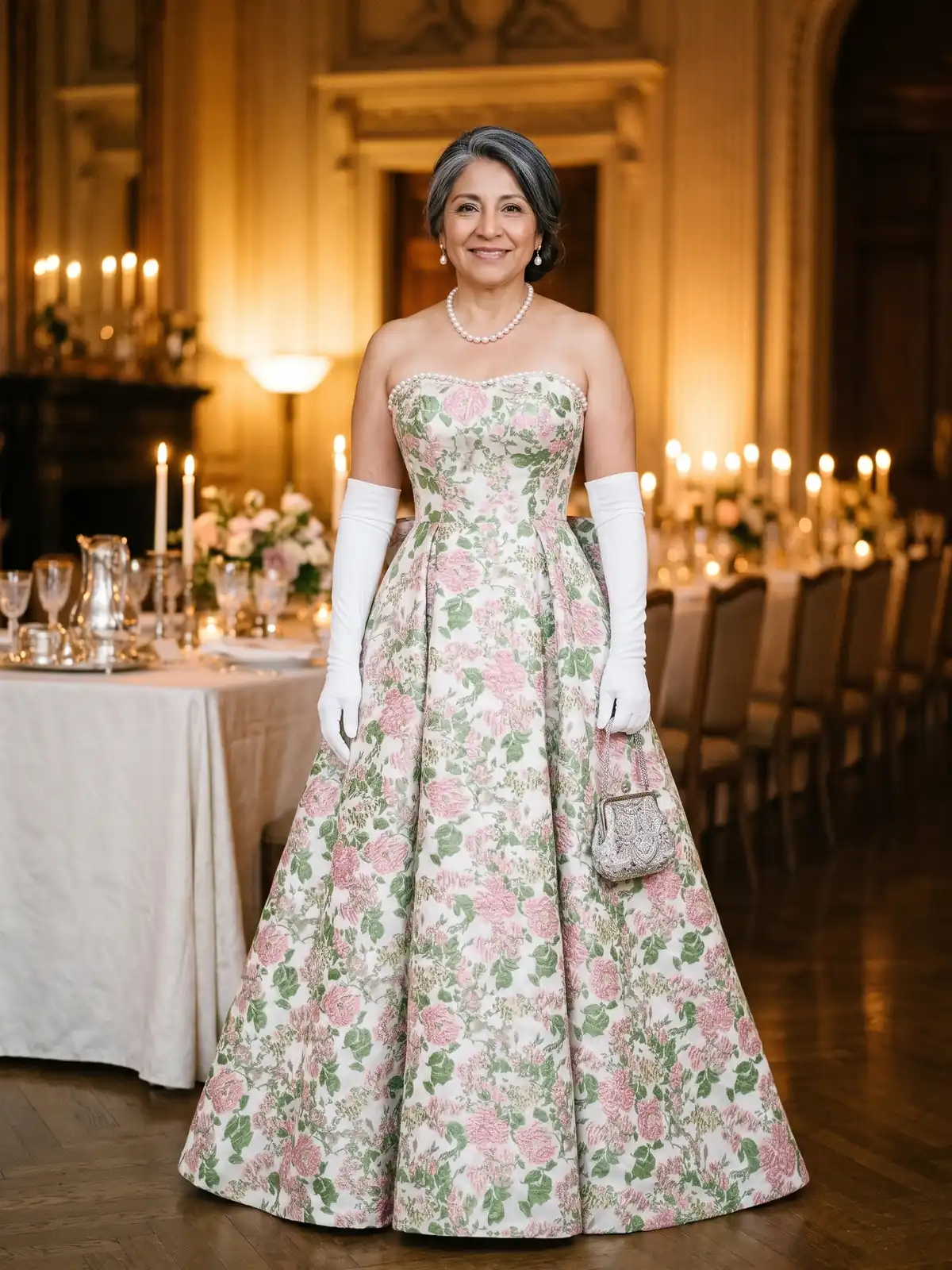
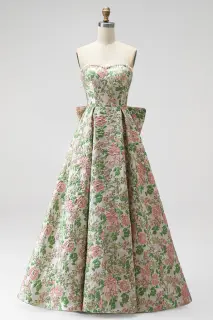 Zapaka Floral Jacquard Strapless Pearl Trim A-Line Ball Gown with Back Bow $175 Shop at Zapakaaffiliate link
The gown in the picture is Zapaka's floral jacquard A-line ball gown, strapless with a pearl-trimmed sweetheart neckline, a full pleated skirt and a large bow at the back (US$175), on a US size 14 in her fifties. The opera gloves above the elbow, the pearls and the silver bag are described, not sold. It meets every rule: floor-length, structured, in a fabric with weight. A full ball skirt is the most traditional white-tie shape, but not the only one.
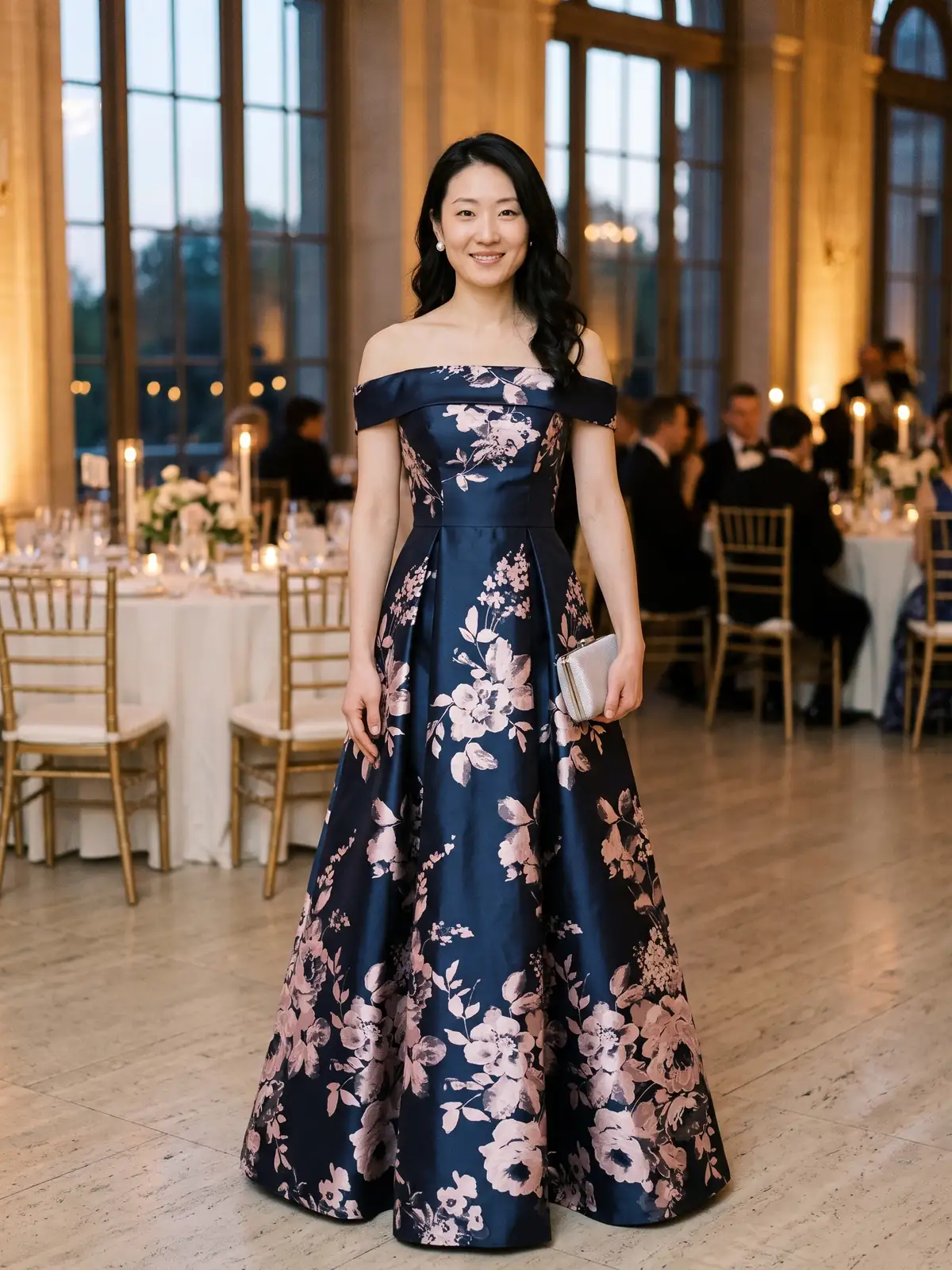
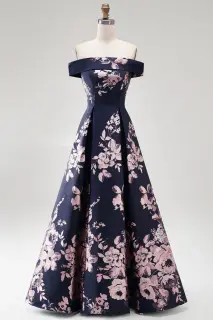 Zapaka Dark Navy Off the Shoulder Floral Printed A-Line Long Formal Dress $139 Shop at Zapakaaffiliate link
Another way in: Zapaka's dark navy off-the-shoulder satin gown with a pale pink floral print (US$139), on a US size 4. Satin works in any season; for a winter ball, velvet is the other fabric the guides name.
Gloves: when to wear them and when to take them off
Long evening gloves are the most recognizable white-tie accessory, and the rules for them are older than the rules for the gown.
- Length follows the sleeve. Cornelia James, the British glovemaker: "the shorter the sleeve, the longer the glove". Opera gloves go over the elbow with a strapless or sleeveless gown; shorter gloves with sleeves. The Magdalene May Ball in Cambridge gives the same rule, and adds that three-quarter sleeves take gloves "that reach the sleeve and overlap them slightly".
- On to greet, off to eat. Cornelia James: "Gloves should be kept on when meeting and greeting fellow party-goers, but should most definitely be removed to dine". Once off, they are folded in half and placed under the napkin on your lap.
- Optional almost everywhere. The Emily Post Institute, the Nobel Foundation, Vogue and the Magdalene ball all call them optional today. Two places still keep them: the International Debutante Ball, where debutantes "must wear white elbow length gloves if the dress is strapless or cap sleeve", and the Rex ball in New Orleans, where ladies in the front two reserved rows "traditionally wear white gloves of a length appropriate to their dress sleeves."
Tiaras
The tiara is the one accessory reserved for white tie. Country Life, writing on tiara etiquette: "Today 'white tie' defines the sort of entertainment where they are still worn". The old convention was that only married women wore them, from their husband's family or their own collection; Country Life writes that "Tiaras are for every class of married woman", and that after the First World War the best invitations carried the phrase "Tiaras will be worn" so that no one was caught out. Wikipedia's article on the tiara notes that "In the 21st century, these rules are no longer strictly applied", and that a tiara is not required at white-tie occasions. In practice: wear one if you own one and the host's circle does; never feel obliged.
White tie vs black tie
| White tie | Black tie | |
|---|---|---|
| Coat | Evening tailcoat, worn open | Dinner jacket (tuxedo), single- or double-breasted |
| Waistcoat or cummerbund | White piqué waistcoat | Black waistcoat or cummerbund |
| Tie | White piqué bow tie | Black bow tie |
| Shirt | Stiff front, wing collar, studs | Soft pleated or piqué front, turndown collar |
| Trouser stripe | Two (UK, Europe) or one (US) | One |
| Gloves | Traditional, now optional | Emily Post: "No gloves" |
| Women | Floor-length gown only | Floor-length in the US; a cocktail dress is common in the UK |
| Decorations | Up to four breast stars in the UK | One star |
The Knot keeps it short: "For men, white-tie requires a tailcoat, black-tie does not." And: "For women, white-tie requires floor-length dresses, while black-tie dresses can be of varying lengths." If you have only a dinner suit, read the invitation carefully. A few hosts, like the Guild of Freemen of the City of London at its Guildhall banquet, write "White Tie Preferred, Black Tie Acceptable"; most white-tie events do not. For the black tie side of the line, see our guides to black tie attire and black tie optional; for the middle ground, formal attire.
Events that still ask for white tie
These are the events whose organizers publish a white-tie code on their own pages.
The Nobel Prize ceremony and banquet, Stockholm. "Gentlemen are required to wear white tie and tails, while ladies should be dressed in an evening gown." The men's specification is the full traditional one: "black trousers with two rows of braid down each leg", a stiff wing collar attached with collar studs, a white low-cut waistcoat, and, for those who hold them, "miniature medals plus up to four breast stars". National costume is accepted instead. Many laureates are fitted by a Stockholm outfitter for the occasion; the chemistry laureate Richard Henderson joked in 2017: "This is only my second ever white tie plus tails fitting – and possibly the last!"
The Vienna Opera Ball (next: February 4, 2027). The 69th ball is held at the Vienna State Opera, and its page states that "the specified dress code must be adhered to by all guests": for women a "floor-length ball gown", where "any color is allowed" but "no traditional costume or festive Dirndl"; for men a "black tailcoat", "white dress shirt", "white bowtie" and "black patent leather shoes". "A gala uniform is also permitted as an option." An entrance ticket for 2027 costs €435, including a €35 solidarity donation. New York has its own Viennese Opera Ball; Resident magazine reported that its 70th edition, on May 8, 2026, kept "white tie and tails for gentlemen, long ball gowns for ladies", and added: "There are few evenings in New York that still hold to that standard."
The Rex ball, New Orleans. Rex has held its Mardi Gras ball since 1873, and its protocol page sets the dress: "floor-length dresses for ladies and white tie and black tails for men". Military guests are encouraged to wear their highest uniform, and the color gold is reserved for the King and Queen of Carnival.
The International Debutante Ball, New York (December 29, 2026, at the Plaza Hotel). Fathers and escorts "should wear full evening dress (black tail coat, black trousers, white shirt with pique front, white pique vest, white tie and, for the escorts, white gloves as well)". Debutantes wear white floor-length gowns, and the ball is firm on color: "Only the evening's debutantes may wear white to the Ball."
Cambridge May Balls. "The dress code for Magdalene May Balls is white-tie compulsory." Most others are black tie: Trinity's May Ball accepts white tie but calls itself a "Black Tie minimum" ball. Wikipedia adds that "Magdalene and Peterhouse hold white tie balls, with Peterhouse beginning this tradition in 1892."
Oxford Commemoration balls. According to Wikipedia, the larger triennial Commemoration balls usually ask for white tie, while the smaller summer balls are usually black tie.
The Gridiron Club dinner, Washington. Wikipedia calls it "one of the few remaining large-scale, white-tie affairs in Washington." We found no page from the club itself.
State dinners. Royal state banquets in Britain are white tie, and Vogue's photo of the Beckhams at a 2024 Buckingham Palace banquet shows it. In the US the custom is rare. When the Bushes received Queen Elizabeth II in May 2007, the White House announced that "the attire for the State Dinner is white tie. This is the first white tie event that the President and Mrs. Bush have hosted." The same fact sheet lists a handful of earlier White House white-tie events, three under President Clinton.
The Met Gala, some years. Wikipedia notes white-tie codes in 2014 and 2022, and that in 2014 several outlets pointed out how hard and expensive traditional white tie was to obtain, even for celebrities. It is not white tie every year.
Renting or buying
Most men rent, and nobody at the event will think less of it. The prices below are those printed on the dates shown.
| Option | Price | Source, date |
|---|---|---|
| Hire, full package (tailcoat, trousers, waistcoat, shirt, bow tie), UK | £234.95 for 7 days | Moss Bros Hire, read November 16, 2026 |
| Hire through a ball, UK | £120 discounted | James of Ely via the Magdalene May Ball, 2025 ball |
| Buy ready-made tailcoat and trousers, US | $521.96 on sale ($579.95 regular) | Dobell, read November 16, 2026 |
| Buy ready-made, UK | £209.99 on sale (£279.99) | Dobell UK, read November 16, 2026 |
| Made-to-measure tailcoat | From $589 | Hockerty, page updated November 2026 |
| Mid-price tailcoat vs bespoke | "less than $300 as opposed to more than $1,000" | The Knot, updated July 30, 2026 |
| Made-to-measure to bespoke | "as little as US$285" to "over $5,000" | Gentleman's Gazette, 2018 to 2020 |
| Gown rental | Retail "nearly $1,000", rent "for less than $150" | The Knot on Rent the Runway |
Dobell's British site goes as far as to say "Buy white tie below for less than it would cost to hire." The other side is Gentleman's Gazette, which says that "In an ideal world you should never rent a tailcoat", calls renting "a perfectly respectable option for a once-in-a-lifetime event", and advises buying the shirt, waistcoat and tie even if you rent the coat. The Black Tux, a rental company, takes the practical view: "For white tie, renting is usually the most practical option". Hockerty, which sells made-to-measure, the opposite: "A rental tailcoat at a state dinner or opera gala isn't just uncomfortable—it's visible."
Our reading: rent if this is your first and perhaps only white-tie evening, but book early (Moss Bros recommends collecting four days before), try everything on, and check the waistcoat length against the coat. Buy if you have two or more events a year, or if you are tall or broad enough that rental sizes fight you. Anyone attending the International Debutante Ball can rent in New York; the ball says so on its FAQ.
What not to wear
- A tuxedo (dinner jacket) instead of a tailcoat, or a lounge suit.
- A black bow tie, a necktie, or a cummerbund. The Knot: "in white-tie, the vest takes the place of a cummerbund."
- Notched lapels, a belt, a wristwatch, matte shoes.
- For women, anything shorter than the floor. Generation Tux: "Your ankles should never be showing at a white-tie event".
- White, ivory or cream at a wedding or a debutante ball.
A short history
The tailcoat comes from the end of the eighteenth century. Wikipedia traces it to the plain dark cutaway coats that replaced embroidered court coats after the French Revolution, and notes that by the Regency era black and white had become the standard colors of evening wear. Black tie arrived in the 1880s as a less formal alternative for dinner parties, and it spread so far after the First World War, and again after the 1960s, that white tie became the exception. Wikipedia records John F. Kennedy as the last president to wear white tie at an inauguration ball, in 1961. For what men wore by day in the 1920s, when white tie was still the evening norm, see 1920s men's fashion.
Where the sources disagree
- One stripe or two. Debrett's and the Nobel Foundation describe two rows of braid. The Emily Post Institute writes "a single stripe of satin or braid in the US", and Gentleman's Gazette says "Single-striped trousers are an acceptable alternative with full-dress". Our reading: two in Britain and Europe, one is fine in the US.
- Single- or double-breasted. Debrett's calls the coat "single-breasted". Gentleman's Gazette calls it "a (pseudo) double-breasted model", and Vogue quotes GQ calling it double-breasted. They agree on the point that matters: it is never fastened.
- Pre-tied bow ties. The Knot recommends "opting for one that comes pre-tied", and Dobell sells its tie "either pre-tied or self-tied". The Tie Bar: "Don't go the easy route and wear a pre-tied or clip-on bow tie". Gentleman's Gazette asks for a tie sized to the neck so that no adjuster shows.
- A tuxedo at a white-tie wedding. Generation Tux writes that "You might be able to wear a traditional tuxedo instead of a tailcoat" at some white-tie weddings. Every etiquette source we read says the opposite.
- Weddings at all. The Tie Bar writes that "White tie is almost never required at weddings" on one page, and "Yes, although rare, weddings can certainly be white tie" on another.
- Time of day. Hockerty's blog says "white tie may apply to events at any time"; its own tailcoat page and every etiquette source say evening only.
- Where it began. Wikipedia places the origins at the end of the eighteenth century and the Regency; Vogue writes that white tie "first emerged in the earlier days of the Victorian Era (around 1840)".
- The last white-tie inauguration. Wikipedia names Kennedy in 1961. The 2007 White House fact sheet lists President Reagan's 1981 inaugural balls among earlier White House white-tie events.
In the United Kingdom, Canada and Australia
United Kingdom. The invitation will usually say "Evening Dress", and, when orders and medals are expected, "Evening Dress – Decorations". The Central Chancery of the Orders of Knighthood's guide sets the British rules: with full evening dress, up to four breast stars, the lowest about six inches above the waist; with a dinner jacket, one. Miniature medals are worn on a bar on the left lapel, and only in the evening. Two lines of braid on the trousers, a detachable wing collar, and court shoes (pumps) are the British norms. White tie survives at state banquets, some City of London dinners, and certain university balls; the Guild of Freemen's Guildhall banquet asks for white tie but accepts black, and notes that "Cocktail dress length does not normally accompany white."
Canada. Canada uses the Commonwealth wording. The Governor General's guide to wearing orders gives "Evening dress – decorations" and "Evening dress – miniatures" as examples, and its rules for insignia with black tie end with "Note: the same rules apply to White Tie and Tails." Gentleman's Gazette notes that the traditional North American wording is "White Tie – Decorations". We found no Canadian white-tie event with a published code, so if you receive one, ask the host how strictly it applies.
Australia. The Department of the Prime Minister and Cabinet's guide to wearing awards says that "At events such as evening receptions and dinners where decorations have been prescribed, the miniature insignia is generally worn", with neck badges in full size. White tie itself is rare; we found no Australian event that publishes a white-tie code, and no local hire price.
Questions people ask
What is white tie attire?
The most formal evening dress code. For men: a black evening tailcoat worn open, a white piqué waistcoat, a stiff-fronted white shirt with a wing collar and studs, a white bow tie, high-waisted black trousers with a silk stripe, and black patent shoes. For women: a floor-length evening or ball gown, with optional long gloves and jewelry.
What is the difference between white tie and black tie?
White tie uses a tailcoat, a white waistcoat and a white bow tie; black tie uses a dinner jacket (tuxedo), a black bow tie and a black waistcoat or cummerbund. Women must wear floor-length at white tie; at black tie a shorter dress is sometimes accepted.
What do women wear to a white tie event?
A floor-length gown in any color except white or ivory at a wedding, in a rich fabric such as satin, velvet or brocade. Long gloves are traditional and optional; a tiara is allowed but never required.
Can you wear a tuxedo to a white tie event?
No. A tuxedo is black tie. A few hosts write "White Tie Preferred, Black Tie Acceptable" on the invitation, and then a dinner suit is fine. Otherwise, rent a tailcoat.
Do women have to wear gloves at white tie?
No. Gloves are optional at almost every event today. If you wear them, keep them on to greet people and take them off to eat. Debutante balls and some Carnival balls still expect white gloves.
Can I rent white tie?
Yes, and most men do. In the UK, a full package costs about £235 from Moss Bros; in New York, the International Debutante Ball says full evening dress can be rented locally. Rent the coat at least, and try it on with the waistcoat before the evening.
Who can wear a tiara?
Traditionally, married women, at white-tie events only. Wikipedia notes that these rules "are no longer strictly applied", and no host requires one today.
Where is white tie still worn?
At the Nobel ceremony and banquet, the Vienna Opera Ball, the Rex ball in New Orleans, the International Debutante Ball in New York, the Magdalene May Ball in Cambridge, Oxford Commemoration balls, the Gridiron dinner in Washington, royal state banquets, and a few US state dinners.
Is white tie ever worn during the day?
No. White tie is an evening code. The daytime equivalent is morning dress, with a morning coat, a waistcoat and striped trousers.
Sources
- Wikipedia: White tie (last edited November 5, 2026)
- The Emily Post Institute: Attire Guide, Dress Codes from Casual to White Tie (2021)
- Debrett's: Do Dress Codes Matter? (October 11, 2022)
- Nobel Prize Outreach: The Dress Code at the Nobel Banquet (updated May 9, 2024)
- Nobel Prize Outreach: The Dress Code at the Nobel Banquet, White Tie and Tails (updated May 9, 2024)
- Nobel Prize Outreach: The Dress Code at the Nobel Banquet, Evening Gown (updated May 9, 2024)
- Nobel Prize Outreach, Manisha Lalloo: The Dress Code (2018, updated 2026)
- Vienna State Opera: The Evening, Vienna Opera Ball
- Vienna State Opera: Tickets, Vienna Opera Ball 2027
- Resident, Norah Lawlor: Seventy Years of White Tie, the Viennese Opera Ball Returns to Cipriani 42nd Street (May 5, 2026)
- Rex Organization: Ball Traditions and Protocol
- International Debutante Ball: FAQs
- International Debutante Ball: History
- Magdalene May Ball: FAQ
- Trinity May Ball: Ticket FAQ
- Wikipedia: May Ball
- Wikipedia: Commemoration ball
- Wikipedia: Gridiron Club
- The White House, Office of the First Lady: Fact Sheet, the State Visit of Queen Elizabeth II (May 4, 2007)
- Gentleman's Gazette, Peter Marshall: White Tie Evening Tailcoat & Trousers (2018, updated 2024)
- Gentleman's Gazette, Sven Raphael Schneider: White Tie DOs and DON'Ts (2018, updated 2024)
- Gentleman's Gazette, Peter Marshall: White Tie Accessories & Shoes (2018, updated 2025)
- Gentleman's Gazette, Sven Raphael Schneider: White Tie Shopping & Buying Guide (2018)
- Gentleman's Gazette, Sven Raphael Schneider: Orders, Decorations & Medals with Black Tie & White Tie (2018, updated 2025)
- The Knot, Elle Cashin: Your Complete White-Tie Attire Guide (updated July 30, 2026)
- Vogue, Hannah Jackson: What Is White Tie? The Definition and Origins of Society's Most Formal Dress Code (April 26, 2022, updated 2026)
- Vogue, Corinne Pierre-Louis: 24 White-Tie Wedding Guest Dresses Fit for the Most Formal Occasions (September 30, 2026)
- Hockerty: Tailcoats
- Hockerty, Anastasia Git: Black Tie vs White Tie, Key Differences Explained (2020, updated 2026)
- The Tie Bar: When Do You Wear White Tie (October 5, 2026)
- The Tie Bar: Can Weddings Be White Tie? (October 22, 2025)
- Dobell: White Tie (US)
- Dobell: White Tie (UK)
- Moss Bros Hire: Tailored Fit White Tie Tails
- The Black Tux: The Complete Guide to Formal Dress Codes for Men
- Generation Tux, Matt Ramirez: The Complete Guide to a White-Tie Event (February 25, 2026)
- Central Chancery of the Orders of Knighthood: A Guide to the Wearing of Orders, Decorations, Miniatures and Medals (2016)
- Office of the Secretary to the Governor General of Canada: Guide for the Wearing of Orders, Decorations and Medals (2013)
- Australian Government, Department of the Prime Minister and Cabinet: Wearing awards
- The Guild of Freemen of the City of London: Guidance on Etiquette at Guild Events
- Country Life: The Traditions of Tiaras (April 20, 2011)
- Wikipedia: Tiara
- Cornelia James: Do You Know How to Wear Long Evening Gloves? (February 10, 2022)
The images in this guide are AI-generated: real garments from our catalogue, shown on our own recurring models and made from the shops' photos of each piece. They are not photographs of real people. Prices are the ones the shops showed on November 21, 2026 and can change. Wear It On Me earns a commission when you buy a garment through an affiliate link in a guide (the links are marked, and it costs you nothing extra); a commission never decides what we recommend. How we make these guides.